Aqua Fitness Equipment: The Complete Guide to Drag, Buoyancy, and Actually Progressing
Quick Answer: Aqua fitness equipment works through two entirely different mechanisms - drag (resistance that increases with your speed) and buoyancy (upward float force you have to work against). Drag equipment like resistance paddles and webbed gloves progresses your effort as you move faster; buoyancy equipment like foam dumbbells and noodles loads you when you push downward. Choosing the wrong type for your goal is the most common reason people plateau in the water.
You’ve been doing aqua fitness for months and it’s stopped feeling hard. The class uses foam dumbbells and you can now move them without effort. The problem isn’t your fitness level - it’s that you’re using buoyancy equipment for a movement pattern that needs drag equipment, and no amount of trying harder fixes a mechanism mismatch.
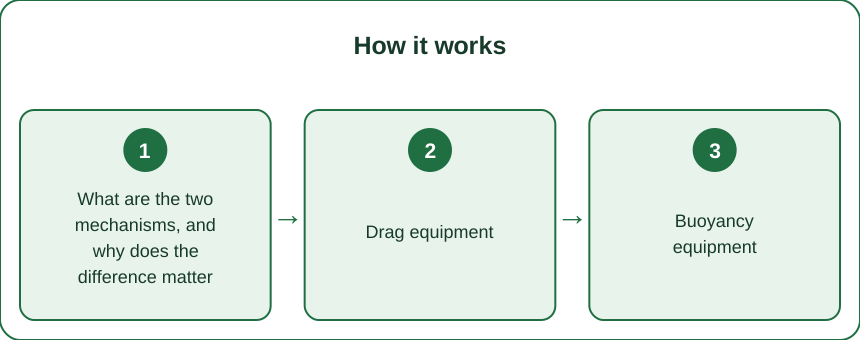
What are the two mechanisms, and why does the difference matter so much?
Almost every piece of aqua fitness equipment works through one of two physical principles, and confusing them is the source of most plateau frustration.
Drag resistance is the force water exerts against an object moving through it. Critically, drag increases with the square of your speed - move twice as fast and you face roughly four times the resistance. It also increases with the surface area facing the direction of travel.
This has a hugely useful property: drag equipment is self-regulating. The same paddle is easy at slow speed and extremely demanding at high speed. You progress by moving faster, not by buying a bigger tool. It’s also joint-friendly, because resistance disappears the instant you slow down - there’s no momentum carrying a load past your control.
Buoyancy resistance is the upward force water exerts on anything less dense than water. Foam dumbbells, noodles, and buoyancy belts all float, which means they resist being pushed downward.
Buoyancy behaves very differently: it’s constant regardless of speed and depends only on the volume of the object. A foam dumbbell provides exactly the same upward force whether you push it down slowly or quickly. Progressing means using a physically larger float.
Why the mismatch matters: if you’re doing a movement that pushes water sideways or backward - a chest fly, an arm sweep, a running motion - buoyancy equipment adds almost nothing, because buoyancy only resists downward movement. You could hold the largest foam dumbbell made and a horizontal chest fly would still feel easy. That’s not a fitness problem. That’s using the wrong mechanism.
The reverse is also true: for pushing down - a tricep press-down, a lat pull-down motion in the water - buoyancy is exactly right and drag paddles add relatively little.
Drag equipment: what each piece does and when to use it
Webbed gloves. The entry point. They increase the surface area of your hand by roughly 30-50%, which increases drag proportionally on every arm movement in every direction.
Best for: general upper-body progression, people transitioning from bare-hand classes, anyone with grip limitations (they strap on rather than requiring a hold). Progression: move faster. Then move through a larger range. Then progress to paddles. Cost: the cheapest meaningful upgrade available in aqua fitness.
Resistance paddles / hand bars. Rigid or semi-rigid flat surfaces held in the hand, offering substantially more surface area than gloves.
Best for: real upper-body strength work, chest and back movements, anyone who’s outgrown gloves. Key detail: most paddles can be turned. Held flat-on to the direction of travel they give maximum drag; turned edge-on they give minimal drag. This means one paddle gives you a full range of intensities by wrist rotation alone - which most people never discover. Watch for: shoulder discomfort. Paddles substantially increase load on the shoulder joint, and increasing speed with large paddles is where aqua fitness shoulder problems come from.
Drag-based ankle equipment (fins, drag socks). Increase resistance on leg movements.
Best for: leg strength, deep-water running, hip mobility work. Caution: fins significantly change ankle and knee loading. Start with short sessions.
Parachutes and drag belts. Worn at the waist, they create resistance to forward travel.
Best for: water walking and running progression, which otherwise plateaus quickly. Note: these are among the most effective and least used tools in recreational aqua fitness.
Buoyancy equipment: what each piece does and when to use it
Foam dumbbells (aqua barbells). The most common piece of equipment in group classes, and the most commonly misused.
What they actually do: resist downward movement. Pushing them from the surface to your hips is genuinely hard. Moving them horizontally is nearly free. Best for: tricep press-downs, lat pull-downs, any downward pressing pattern, and core work where you’re stabilising against an upward pull. Progression: larger diameter. Sizes typically run small, medium, large, with meaningful differences between them. The mistake: using them for horizontal movements and concluding aqua fitness isn’t challenging. Held out to the sides in a horizontal fly, a foam dumbbell contributes almost nothing.
Noodles. Cheap, versatile, and genuinely useful when used deliberately.
Best for: core work (straddling a noodle and stabilising is a demanding core exercise), assisted deep-water positioning, and downward-press movements. Progression: fold it in half to double the buoyancy, or use two.
Buoyancy belts. Worn at the waist to keep you vertical in deep water.
Best for: deep-water running and deep-water intervals - the highest-intensity, lowest-impact format aqua fitness offers. Important nuance: a belt makes the workout easier in one sense (you don’t have to tread to stay up) and harder in another (it enables sustained hard effort you couldn’t otherwise maintain). For anyone with joint limitations wanting genuinely hard cardio, deep-water running with a belt is often the single best option available.
Ankle floats. Resist downward leg movement and challenge core stability considerably.
Best for: advanced core work, hip strength. Caution: they significantly increase the difficulty of maintaining a vertical position. Not a beginner tool.
How do you actually progress, session to session?
The reason so many people plateau is that they treat equipment as binary - you either use it or you don’t - when there are at least five progression variables available before you need to buy anything new.
Variable 1: Speed. For any drag equipment, this is the primary lever and the most underused. Because drag scales with the square of velocity, moving 30% faster increases resistance by roughly 70%. Most people plateau because they keep the same tempo forever.
Variable 2: Surface orientation. Rotating a paddle from edge-on to flat-on can multiply resistance several times over with no change in equipment. Practise deliberately switching mid-set.
Variable 3: Range of motion. A longer path through the water means more total work. Extending a movement’s range is a genuine progression.
Variable 4: Water depth. Chest-deep water provides more resistance to upper-body movement than waist-deep. Moving to a deeper part of the pool changes the workout without changing anything else.
Variable 5: Lever length. A straight arm sweeping through water is dramatically harder than a bent arm doing the same movement, because the equipment is further from the shoulder. This is free progression.
Only after exhausting these does buying a larger or more aggressive piece of equipment make sense.
A practical progression order for a beginner: bare hands with attention to speed (weeks 1-4) → webbed gloves (weeks 4-10) → foam dumbbells for downward patterns, gloves retained for everything else (weeks 10-16) → paddles introduced for upper-body strength work (month 4+) → drag belt or deep-water belt for cardio progression (month 5+).
That’s roughly a five to six month progression, which is a realistic pace and considerably slower than most people attempt.
What are the most common equipment mistakes?
1. Using buoyancy equipment for horizontal movements. Covered above, and it’s the single most common cause of ‘aqua fitness stopped being hard.’ Check your movement direction: if you’re not pushing down, buoyancy isn’t loading you.
2. Buying large foam dumbbells before mastering speed. A larger float doesn’t make a horizontal movement harder. Speed does, on drag equipment. Diagnose the mechanism before buying.
3. Adding paddles without building shoulder capacity first. Paddles substantially increase shoulder joint load. Going from bare hands to large paddles in one step is a common route to shoulder irritation. Gloves for at least six weeks first.
4. Ignoring the pool depth variable entirely. Many people do every session in the same spot. Moving 2 metres to slightly deeper water changes the resistance profile of your entire session for free.
5. Using equipment on both limbs when unilateral would be better. Single-arm and single-leg work in water is excellent for correcting asymmetries and adds a core stability demand, and hardly anyone does it.
6. Keeping the same tempo for months. Drag resistance is speed-dependent. Same tempo forever means same resistance forever, regardless of what you’re holding.
7. Not accounting for equipment when judging effort. A session with paddles at moderate speed can be genuinely harder than a session with bare hands at maximum speed. Perceived effort is a better guide than session length.
8. Skipping equipment entirely because a class doesn’t provide it. Webbed gloves cost very little, pack flat, and can be brought to any class.
What equipment is actually worth buying yourself?
Most pools provide foam dumbbells and noodles. What they usually don’t provide is the equipment that would move you past a plateau.
Worth buying, in priority order:
1. Webbed gloves. Cheapest, most versatile, work for every arm movement in every direction. If you buy one thing, this is it. Look for a snug fit - loose gloves let water through and reduce the effect.
2. Resistance paddles, once gloves feel easy at speed. Choose a moderate size rather than the largest available; the rotation trick gives you the range you need. Look for adjustable straps rather than a grip-only design if you have any hand or wrist issues.
3. A buoyancy belt, if deep-water work is available at your pool. This unlocks the highest-intensity, lowest-impact format aqua fitness has, and pools frequently don’t stock enough of them.
4. A drag belt or parachute, if water walking or running is your main format. This is the piece that breaks the water-walking plateau most directly.
Generally not worth buying yourself: foam dumbbells (pools have them, they’re bulky to transport), noodles (same), ankle floats (specialised, and most people don’t reach the level where they help).
A note on cost: the entire priority list above typically costs less than a couple of months of class fees, and it’s what determines whether those classes keep producing results in month twelve.
Before adding any new equipment: if you have joint issues, shoulder problems, or any medical condition affecting exercise, run the change past a physiotherapist or doctor. Equipment meaningfully changes joint loading, and that’s exactly the kind of change worth checking. This is general information, not medical advice.
FAQ: Aqua Fitness Equipment Questions, Answered
Can I use swimming equipment like hand paddles for aqua fitness?
Swimming paddles are designed for a different movement pattern and often have sharp edges that catch awkwardly in vertical exercises. Purpose-made aqua fitness paddles are shaped for multi-directional movement and are worth the difference.
How do I know when I’ve outgrown my current equipment?
When you can complete a full set at your maximum sustainable speed with full range of motion and it doesn’t feel demanding. If you haven’t tried maximum speed, you haven’t outgrown it yet.
Is more equipment always better?
No - using several pieces at once often compromises technique. One well-chosen piece used with good speed and range beats three used carelessly.
Does equipment increase injury risk?
It increases joint load, particularly at the shoulder with paddles. Progressing gradually and stopping at any joint pain manages most of that risk. This is general information, not medical advice.
What if my class doesn’t allow personal equipment?
Webbed gloves are almost universally permitted since they don’t take up space or create hazards. Larger paddles are sometimes restricted in crowded classes.
TL;DR:
- Aqua equipment works by drag (speed-dependent) or buoyancy (constant, downward-resisting) - these are not interchangeable
- Buoyancy equipment does almost nothing for horizontal movements, which is the most common plateau cause
- Drag resistance scales with the square of speed, so tempo is your biggest free progression
- Five variables to exhaust before buying: speed, surface orientation, range, depth, lever length
- Worth buying: webbed gloves first, then paddles, then a buoyancy or drag belt
- Build shoulder capacity with gloves for six weeks before introducing paddles
The water didn’t get easier. You’ve been progressing the wrong variable. This is general information, not medical advice.
Keep Reading
This article is for general informational purposes only and is not medical advice. Always consult a qualified health professional for guidance specific to you.