Why Your Heart Rate Is Lower in Water and How to Judge Effort Properly
Quick Answer: Heart rate in water typically runs 10 to 20 beats per minute lower than on land at the same effort, and up to around 17 beats lower in cooler water. This happens because water pressure improves blood return to the heart, so each beat moves more blood, and because water carries heat away faster so you need less circulation for cooling. Use rate of perceived exertion and a talk test rather than land heart-rate zones, or subtract roughly 10 to 15 beats from your land targets.
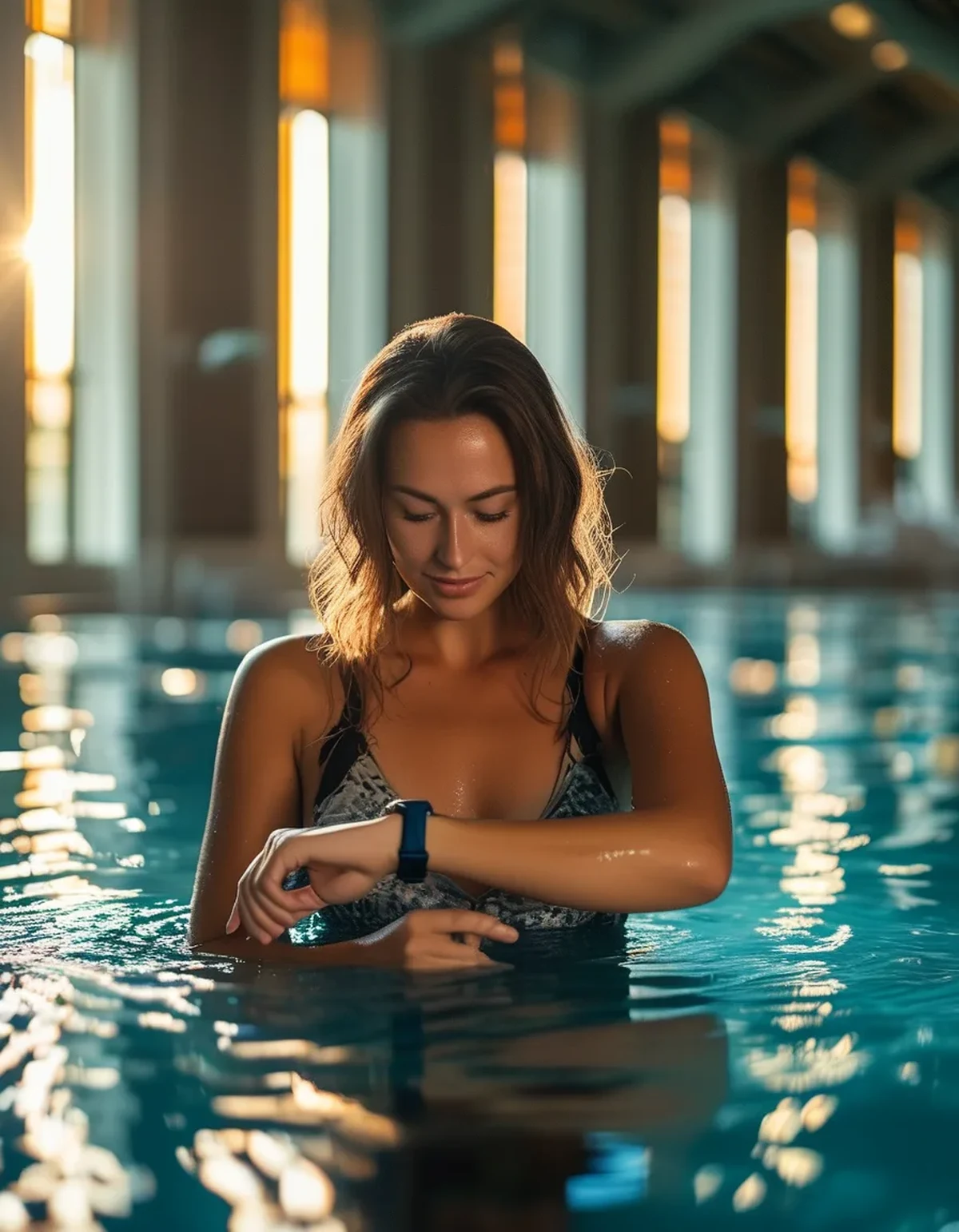
You finish a water class genuinely tired, look at your watch, and it says 118. On land that number means a brisk walk. Something is clearly wrong - except nothing is wrong, and the number is accurate.
What does water actually do to your heart rate?
Four separate physiological effects push in the same direction, which is why the difference is consistent enough to plan around.
Hydrostatic pressure improves venous return. Standing chest-deep, the water exerts pressure on your legs and abdomen, which pushes blood from the peripheral veins back towards the chest. Central blood volume increases, the heart fills more completely between beats, and stroke volume rises - each beat moves more blood. To deliver the same cardiac output, the heart needs fewer beats. This is the largest single factor.
Improved thermal conduction reduces the cooling demand. Water conducts heat roughly 25 times more effectively than air. On land, a substantial share of your circulation is diverted to skin for cooling during exercise. In water, heat leaves your body far more efficiently, so less blood flow is needed for temperature regulation and heart rate stays lower for the same work.
The diving reflex contributes when the face is wet. Facial immersion in cool water triggers a reflex slowing of heart rate. It is a modest effect during standing water exercise but a real one, and larger in cooler water and during face-in swimming.
Reduced gravitational load changes the muscular demand. Buoyancy offloads the body - chest-deep immersion reduces effective weight substantially - so postural muscles work differently than on land.
All four are normal responses. A lower heart rate in the pool is not evidence that the session was easy.
How much lower, and what changes the size of the difference?
Research comparing water and land exercise at matched intensities has generally found heart rates around 10 to 20 beats per minute lower in water, with some studies reporting differences of about 17 beats in cooler water and smaller differences in warmer pools.
The size of the gap depends on several things you can identify in your own pool:
Water temperature. The biggest variable. In cooler water - roughly 26 to 28C - the difference is larger because cooling is very efficient and the diving reflex contributes more. In warm therapy pools at 32 to 34C, the difference shrinks, and in genuinely hot water heart rate can actually rise because your body is struggling to shed heat.
Immersion depth. Deeper immersion means more hydrostatic pressure and more effect. Waist-deep produces a smaller difference than chest-deep, and deep-water suspended work produces the largest.
Whether your face gets wet. Facial immersion adds the diving reflex. Standing classes with the head out produce less of it than swimming.
Your own fitness and fluid status. Better-trained people show larger stroke volume responses. Dehydration reduces the effect, which is worth knowing because it is easy to arrive at a pool session under-hydrated.
Body composition. More body fat means more insulation and slower heat loss, which reduces the thermal part of the effect.
Practical consequence: the gap for you in your pool is fairly stable session to session. Working out your own number once is more useful than any published average.
Why do land heart-rate zones fail in the pool?
Because every standard zone system is built on land-based maximum heart rate, and your maximum heart rate in water is also lower - not just your working heart rate.
So if you use a formula like 220 minus age to estimate your maximum and then take 70 to 80 percent of it for a moderate zone, the target you get is a land target. Applied in water, you will chase a number your cardiovascular system does not need to reach for that effort, and the only way to reach it is to work far harder than intended.
This produces two opposite errors, both common:
Error one - overworking. You push to hit 140 because that is your usual moderate zone, and end up at an effort that would be a hard interval on land. People do this for weeks, wonder why aqua fitness feels exhausting, and conclude the water is deceptive.
Error two - underworking and dismissing it. You see 115 on the watch, conclude the class is not doing anything, and either drift through it or abandon water training entirely. This is the more common one and it is why aqua fitness has an undeserved reputation as easy.
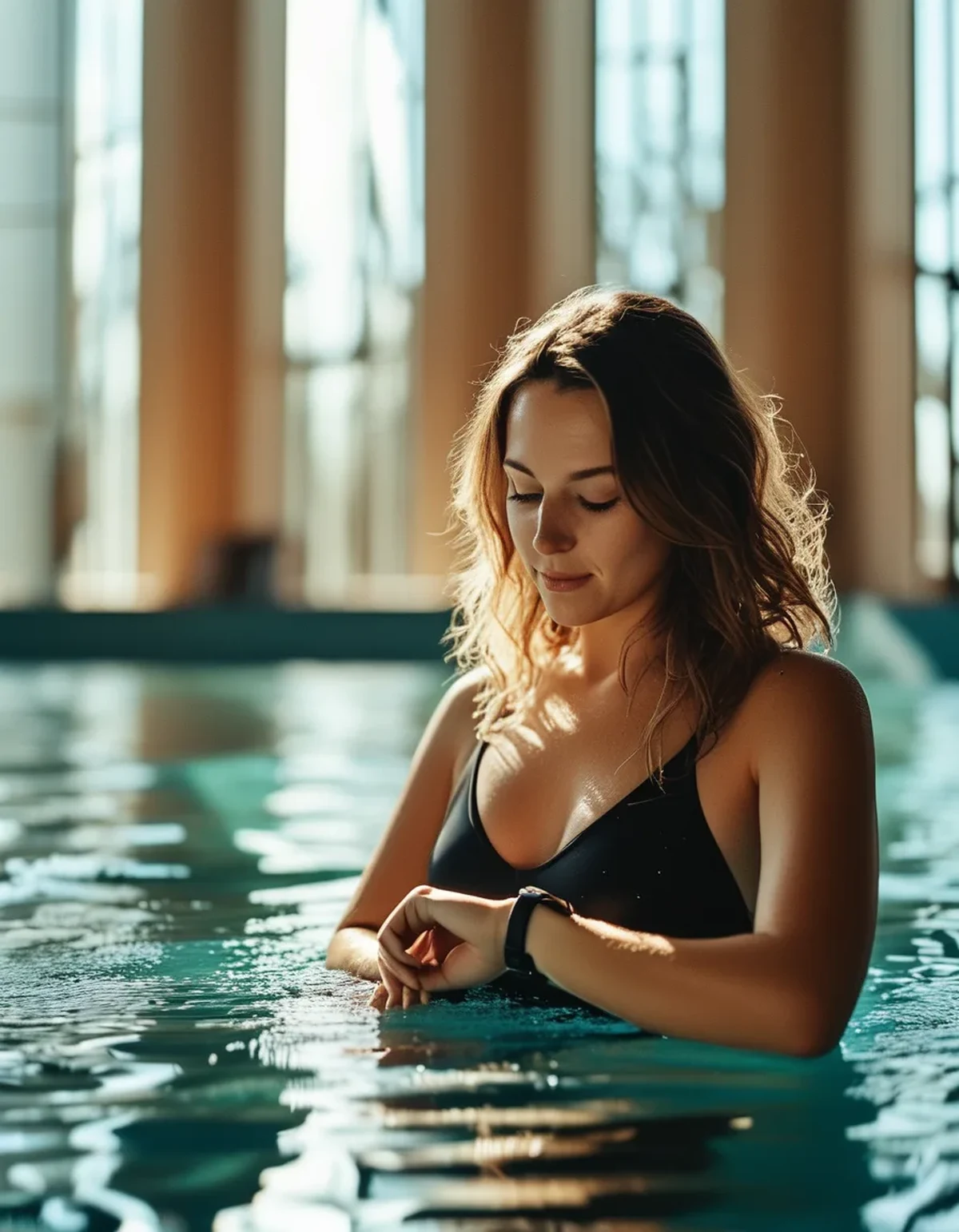
There is a further complication with wrist monitors. Optical wrist-based heart rate is significantly less reliable in water - the water interferes with the sensor, and constant arm movement against resistance adds motion artefact. Chest straps designed for swimming are far more accurate. If your only data source is an optical wrist reading in a pool, treat the number as a rough indication rather than a measurement.
What should you use instead?
Two tools, neither requiring a device, and both more reliable in water than heart rate.
Rate of perceived exertion (RPE), 1 to 10. Rate how hard the effort feels overall - breathing, muscular effort, and how long you think you could keep going.
- 3 to 4 - easy, warm-up and recovery, could talk indefinitely
- 5 to 6 - moderate, conversation possible in short sentences, this is where most of a class should sit
- 7 to 8 - hard, a few words at a time, appropriate for intervals
- 9 to 10 - maximal, unsustainable, rarely needed
RPE correlates well with actual physiological strain and is not affected by water at all, which makes it the primary tool rather than a fallback.
The talk test. Simple and surprisingly precise. Full sentences comfortably means easy. Short sentences with a breath between means moderate. Only a few words means hard. Most guidance on moderate-intensity activity maps closely onto the short-sentences level.
If you want to keep using heart rate, calibrate it yourself:
- Warm up in the water, then hold an effort you would call a clear 6 out of 10 for three minutes and note your heart rate
- Do the same on land - a brisk walk or easy cycle at the same RPE - and note that heart rate
- The gap between them is your water offset, and it will typically be somewhere between 10 and 20 beats
- Subtract that offset from your land zones for pool sessions
Repeat it once a season, or if you change pools - because water temperature moves the number.
How do you structure a water session using effort rather than heart rate?
A concrete session, built entirely on RPE, that gives you a genuine training stimulus.
Warm-up, 8 minutes. Water walking forwards and backwards, arm swings through the water, gradually larger movements. RPE 3 to 4. In cooler water take longer, because you will feel cold before you feel warmed up.
Main set option A - intervals, 20 minutes. 40 seconds hard (RPE 7 to 8), 80 seconds easy (RPE 4), 10 rounds. Hard efforts can be high-knee runs, jump squats, or fast arm sculling with resistance. The interval structure is what generates the cardiovascular stimulus.
Main set option B - continuous, 25 minutes. Steady water jogging or deep-water running at RPE 5 to 6, the short-sentences level. Less exciting and genuinely effective for aerobic base.
Strength block, 12 minutes. Resistance work using paddles, noodles, or just the water - 12 to 15 repetitions per movement, slowly, at RPE 6 to 7. Slow is the key: water resistance rises with speed, but slow controlled movement keeps the muscle under tension for longer.
Cool-down, 5 minutes. Easy walking and gentle stretching at RPE 2 to 3.
Two things to watch that land sessions do not require:
Hydration. You sweat in water and cannot see it, so thirst arrives late. Keep a bottle at the poolside and drink every ten minutes or so.
Temperature. In water below about 28C, standing still gets cold quickly, so keep moving during rest intervals rather than stopping. In water above 32C, monitor how you feel - warm water plus hard effort raises heat strain and heart rate rather than lowering it.
What Nobody Tells You About Water Intensity
Aqua fitness has an easy reputation largely because of a measurement artefact. Decades of participants looked at low heart rates and concluded the work was minimal. Studies matching effort properly have repeatedly found water exercise producing comparable cardiovascular and strength adaptations to land equivalents, particularly in older adults and people with joint pain.
Water resistance scales with the square of your speed. Double the speed of a movement and the resistance is roughly four times greater. This is why the same exercise can be gentle rehabilitation or a hard interval with no equipment change - the water gives you exactly as much as you ask of it, which is its best feature and the reason it is so easy to under-use.
Your recovery is genuinely faster. Lower cardiac strain, lower impact, and the massage-like effect of hydrostatic pressure mean water sessions typically produce less next-day soreness. That means you can often train more frequently, which is a real advantage rather than evidence the session was too easy.
Cold water masks effort in the other direction. In a cool pool you may feel comfortable while working hard, because the heat that normally tells you you are working is being carried away. RPE is more reliable than temperature sensation here - judge by breathing and muscle effort, not by whether you feel hot.
Blood pressure medication changes the picture. Beta blockers blunt heart rate response, which combined with the water effect makes heart rate nearly meaningless as an intensity guide. RPE is the appropriate tool. If you take cardiac medication or have a heart condition, discuss pool exercise intensity with your doctor before starting. This is general information, not medical advice.
FAQ: Water Heart Rate Questions, Answered
Should I just add 10 to 15 beats to my pool heart rate to compare with land?
That is a reasonable rough adjustment, and calibrating your own offset once with a matched-RPE test makes it much more accurate. The offset varies with water temperature and depth, so check it again if you change pools.
Do waterproof fitness trackers give accurate heart rate in a pool?
Optical wrist sensors are considerably less reliable in water - the water interferes with the sensor and arm movement adds noise. A swim-rated chest strap is far more accurate. Otherwise, treat wrist numbers as indicative.
Is it possible to get a proper cardiovascular workout in water?
Yes. Studies of structured water exercise show meaningful improvements in aerobic capacity, strength, and blood pressure, particularly in older adults and people with joint pain. The intensity has to be real - which is why interval structure and RPE matter.
Why do I feel more tired after a water class than the numbers suggest?
Because the numbers are understating the work, and because water exercise recruits stabilising muscles continuously to hold position against moving water. The fatigue is real and the heart rate is simply the wrong measure of it.
Does water temperature really matter that much?
Yes. Cooler water increases the heart-rate difference and makes you feel less hot at the same effort; very warm water can raise heart rate and heat strain. If your pool changes temperature seasonally, expect your numbers to shift with it.
TL;DR:
- Heart rate runs about 10 to 20 beats lower in water at the same effort, sometimes more in cool pools
- Hydrostatic pressure raises stroke volume, and water carries heat away, so fewer beats are needed
- Land heart-rate zones do not transfer, because maximum heart rate is also lower in water
- Use RPE and the talk test as primary tools, and calibrate your own offset once with a matched-effort test
- Water resistance rises with the square of your speed, so intensity is entirely in your control
- Optical wrist heart rate is unreliable in pools - use a swim chest strap or ignore the number
The low number on your watch is not a verdict on your session. It is a normal, well-documented consequence of standing in water, and once you switch to judging effort by breathing and perceived exertion, water training stops looking like the easy option and starts being measurable.
Keep Reading
This article is for general informational purposes only and is not medical advice. Always consult a qualified health professional for guidance specific to you.