What Research Actually Shows About Aqua Fitness and Bone Density
Quick Answer: Aqua fitness offers real cardiovascular and joint-friendly strength benefits for people with osteoporosis, but water’s buoyancy reduces the gravitational loading that specifically stimulates bone density gains — it’s best paired with, not substituted for, some land-based weight-bearing exercise.
Aqua fitness gets recommended constantly for osteoporosis, and it deserves the recommendation for several real reasons — but the specific claim that it builds bone density the way land exercise does isn’t well supported, and that nuance matters.

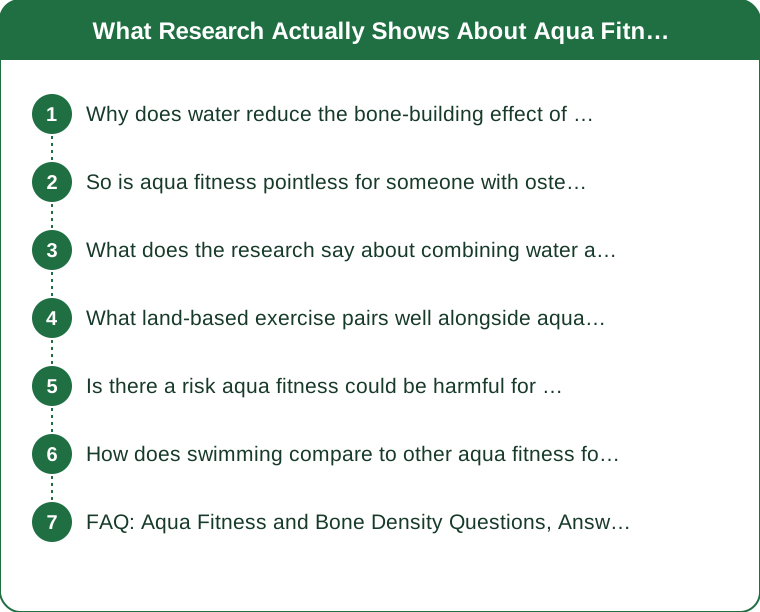
Why does water reduce the bone-building effect of exercise?
Bone density improvements are driven largely by mechanical loading — the stress gravity and impact place on bone, which triggers a remodeling response. Buoyancy in water reduces that gravitational load by roughly 90% at chest depth, which is exactly why water exercise feels easier on joints.
That same buoyancy that protects joints is the mechanism that limits the bone-loading stimulus — it’s a genuine trade-off, not a flaw in aqua fitness as a modality.
So is aqua fitness pointless for someone with osteoporosis?
No — it’s valuable for several other reasons that matter enormously for someone managing osteoporosis: improved balance and coordination (which reduces fall risk, a major concern since falls are what cause most osteoporotic fractures), cardiovascular fitness, and muscular strength.
Muscle strength itself indirectly supports bone health and joint stability, even without direct bone-loading benefit — a stronger body is a more fall-resistant body.
What does the research say about combining water and land exercise?
Several studies on postmenopausal women and osteoporosis populations point toward combined programs — water-based cardio and strength alongside some land-based weight-bearing activity — as more comprehensive than either alone.
The water portion handles cardiovascular fitness and low-impact strength safely; the land portion (even short bouts of walking or gentle resistance training) provides the loading stimulus water can’t.

What land-based exercise pairs well alongside aqua fitness?
Walking, gentle resistance training with bands or light weights, and balance-focused exercises like standing on one leg are commonly recommended additions — none of these need to be intense to contribute meaningful loading benefit.
Even 15-20 minutes of land-based weight-bearing activity a few times a week, alongside regular aqua fitness sessions, is a commonly cited combined approach in physical therapy guidance for osteoporosis.
Is there a risk aqua fitness could be harmful for osteoporosis?
Generally aqua fitness is considered low-risk and is often specifically recommended because it avoids high-impact stress that could be risky for someone with reduced bone density and higher fracture risk.
The main caution is sudden, forceful movements against water resistance in certain positions, which some physical therapists flag for individuals with significant vertebral bone loss specifically — this is worth discussing with a provider familiar with your bone density scan results.
How does swimming compare to other aqua fitness formats for this purpose?
Swimming itself is even lower-impact than water aerobics classes, since it removes vertical loading almost entirely — water aerobics classes involving standing, jumping jacks in water, or resistance movements against the water provide a bit more muscular loading than laps alone.
For bone health specifically, water aerobics classes with resistance elements are generally considered a better complement than swimming laps alone, though both offer cardiovascular benefit.
FAQ: Aqua Fitness and Bone Density Questions, Answered
Can aqua fitness alone prevent osteoporosis?
It’s unlikely to be sufficient alone for building bone density specifically, based on current research, though it contributes meaningfully to overall fitness and fall-risk reduction, which matters just as much for fracture prevention.
Should I stop aqua fitness if I’m diagnosed with osteoporosis?
No — most guidance recommends continuing or starting aqua fitness for its balance, strength, and cardiovascular benefits, ideally alongside some land-based weight-bearing activity.
How often should I add land-based exercise?
A commonly cited pattern is 2-3 sessions per week of light weight-bearing activity alongside regular aqua fitness, though individual recommendations should come from a doctor or physical therapist familiar with your bone density results.
Does resistance in the water (using webbed gloves or water weights) help at all?
It increases muscular strength benefit meaningfully, though it still doesn’t replicate gravitational bone loading the way land-based resistance training does.
TL;DR:
- Water’s buoyancy reduces gravitational loading, which limits direct bone-density benefit compared to land exercise
- Aqua fitness still meaningfully helps balance, cardiovascular fitness, and muscular strength — all relevant to osteoporosis management
- Combining aqua fitness with some land-based weight-bearing activity is the approach most supported by research
- Water aerobics with resistance elements offers more muscular benefit than swimming laps alone
This is general information, not medical advice — talk to a doctor or physical therapist about an exercise plan suited to your specific bone density results.
Keep Reading
This article is for general informational purposes only and is not medical advice. Always consult a qualified health professional for guidance specific to you.