Why Aqua Fitness Might Be the Best-Kept Secret for Perimenopause Joint Pain
Quick Answer: Declining estrogen during perimenopause increases joint inflammation and stiffness for many women, and water’s buoyancy removes up to 90% of body weight impact on joints while still providing enough resistance for real strength and cardio benefit — making aqua fitness one of the few workout formats that adapts well to this specific transition.
Joint pain that shows up seemingly out of nowhere in your 40s or early 50s is one of perimenopause’s most underdiscussed symptoms, and it often makes the workouts you used to rely on suddenly feel much harder on your body.

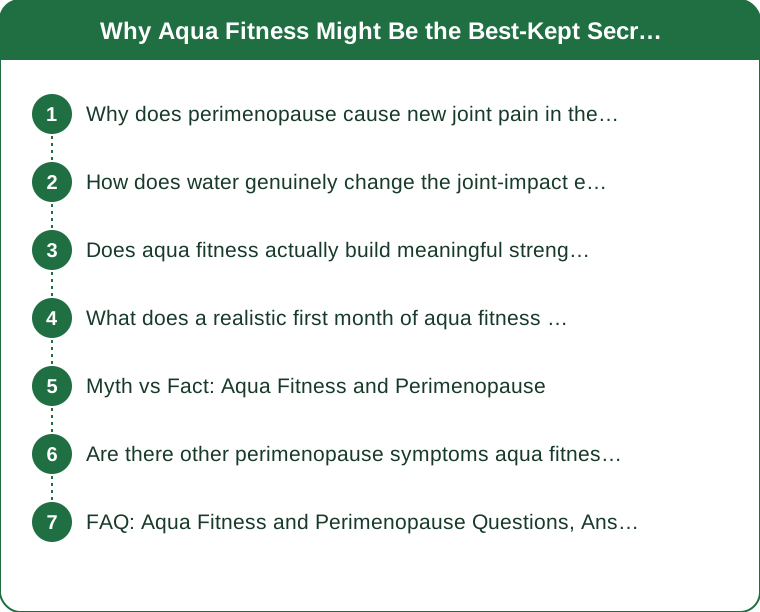
Why does perimenopause cause new joint pain in the first place?
Estrogen plays a role in regulating inflammation and cartilage health throughout the body, and as levels decline and fluctuate during perimenopause, many women notice new joint stiffness, achiness, or pain that wasn’t present before — often in the knees, hips, and hands specifically. This isn’t the same as arthritis, though it can feel similar, and it frequently catches women off guard because it isn’t widely discussed as a perimenopause symptom the way hot flashes or sleep changes are.
The timing matters: this joint change often overlaps with the exact years many women are trying to increase exercise to manage other midlife health markers, which creates a frustrating mismatch between what your body needs and what feels achievable.
How does water genuinely change the joint-impact equation?
Standing in chest-deep water reduces the effective load on weight-bearing joints by roughly 75-90% compared to the same movement on land, because buoyancy counteracts gravity’s pull. This means a walking or jogging motion that would jar an inflamed knee on pavement becomes something the joint can tolerate comfortably in water, while still requiring the muscles to work against water’s resistance in every direction of movement — not just against gravity.
This combination (low impact, real resistance) is genuinely difficult to replicate with any land-based low-impact option; most land alternatives either reduce impact and resistance together (like gentle stretching) or keep resistance high with the impact still present.
Does aqua fitness actually build meaningful strength, or is it just gentle movement?
Water is roughly 800 times denser than air, meaning every push, kick, and arm movement works against real resistance in every direction — not just when lifting against gravity like most land exercises. Studies on aquatic resistance training have shown measurable strength and cardiovascular improvements comparable to land-based training for many populations, while participants report significantly less joint discomfort during and after sessions.
For someone managing new perimenopause joint pain specifically, this means aqua fitness isn’t a compromise or a ‘lesser’ workout — it can deliver comparable fitness benefits with a joint-impact profile land workouts simply can’t match.

What does a realistic first month of aqua fitness for joint pain look like?
Most people start with one to two classes per week, focusing on basic movements — water walking, gentle leg lifts, arm work with the water’s resistance — before progressing to more dynamic movements like jogging or jumping jacks in the water. The first few sessions often feel easier than expected on the joints specifically, which can be a genuine relief after months of land workouts feeling increasingly uncomfortable.
By week three or four, many people add light equipment (pool noodles, water dumbbells) to increase resistance further, continuing to build strength without reintroducing the impact that was causing joint discomfort in the first place.
Myth vs Fact: Aqua Fitness and Perimenopause
Myth: Water workouts are only for older adults or people in physical therapy. Fact: Aqua fitness classes serve a wide range of ages and fitness levels, and many serious athletes use pool training specifically for its strength benefits with reduced joint strain.
Myth: You can’t get an effective cardio workout in water. Fact: Deep-water running and structured aqua interval classes can raise heart rate comparably to land cardio, just with a different, often more comfortable, joint experience.
Myth: Perimenopause joint pain means you should stop exercising until it resolves. Fact: Appropriate movement, especially low-impact options like water workouts, is generally recommended to help manage inflammation and maintain strength during this transition, rather than avoiding exercise altogether.
Are there other perimenopause symptoms aqua fitness happens to help with?
Beyond joint comfort, many women report that regular aqua fitness helps with sleep quality and mood, both commonly disrupted during perimenopause, likely through the combined effect of moderate cardiovascular exercise and the calming, rhythmic nature of water-based movement. Some also find the cooler water temperature genuinely relieving during a period when hot flashes make land-based, sweat-heavy workouts feel considerably less appealing.
This overlap of benefits is part of why aqua fitness comes up repeatedly as a recommendation specifically for this life stage, rather than as a generic low-impact suggestion.
FAQ: Aqua Fitness and Perimenopause Questions, Answered
How many days a week should I do aqua fitness for joint pain relief?
Two to three sessions a week is a reasonable starting point for most people, allowing enough frequency to notice benefit without overdoing a new routine.
Will aqua fitness help with perimenopause weight changes too?
It can contribute to overall calorie expenditure and muscle maintenance, which support weight management, though diet and other factors play a larger combined role.
Do I need to be a strong swimmer to try aqua fitness classes?
No — most classes take place in chest-to-shoulder-deep water where participants stand rather than swim, so swimming ability isn’t required.
TL;DR:
- Declining estrogen during perimenopause commonly increases joint inflammation, often surprising women in their 40s and 50s
- Water reduces joint impact by roughly 75-90% while still providing real strength-building resistance
- A gradual first month (1-2 classes weekly, progressing to added resistance) builds comfort and strength together
- Aqua fitness also often helps with sleep and mood, two other common perimenopause symptoms
If land workouts have started feeling newly uncomfortable on your joints, a few weeks of aqua fitness is a low-risk way to test whether the format fits your body better right now. This is general information, not medical advice.
Keep Reading
This article is for general informational purposes only and is not medical advice. Always consult a qualified health professional for guidance specific to you.