Taking Your Pool Strength to Land: The Complete Transition Guide
Quick Answer: Aqua fitness builds cardiovascular capacity, muscular endurance, and range of motion that transfer well to land. What does not transfer is eccentric strength, impact tolerance, and bone loading - because water removes both gravity and the lowering phase of most movements. A safe transition adds land-based work gradually over 8 to 12 weeks, starting with slow controlled lowering and progressing to loaded and low-impact movements before anything jarring.
People who have trained in water for months are often surprised by how sore they are after their first gym session. It isn’t a fitness problem. The water was removing an entire half of every exercise, and land puts it back.
This is general information, not medical advice. If you moved to water training because of joint pain, injury, or a medical condition, plan the transition with a physiotherapist rather than alone.

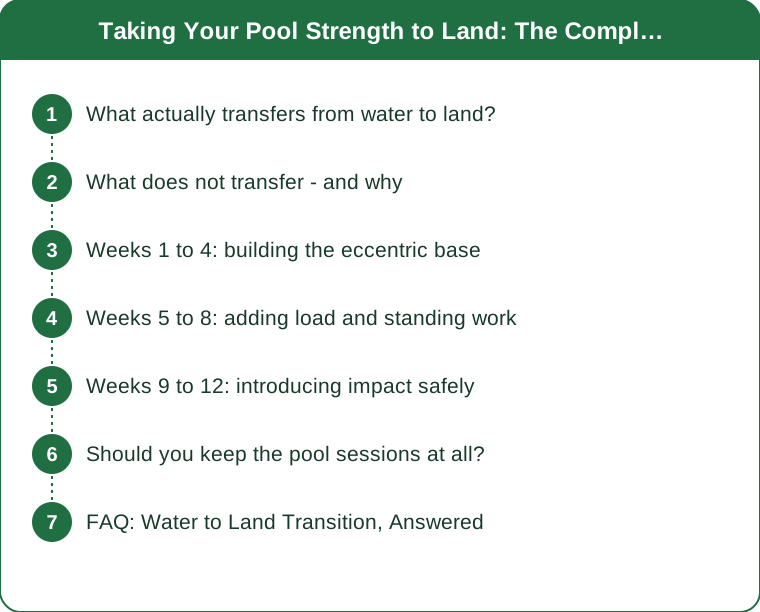
What actually transfers from water to land?
More than you might expect on the cardiovascular side, and less than you’d hope on the strength side.
Transfers well:
- Cardiovascular fitness. Heart and lung adaptations are general. If you can sustain 40 minutes of deep water running, your aerobic base is genuinely built and it carries directly onto a bike, a walk, or a rower.
- Muscular endurance. Water’s constant resistance in both directions builds impressive endurance in the muscles that move you through it - hip flexors, hip extensors, shoulders, and the trunk.
- Range of motion. Warm water and reduced load allow larger, more comfortable ranges. That range remains available on land, though you’ll need to build strength through it.
- Movement confidence and coordination. Underrated, and it’s the reason people who did aqua fitness after an injury often progress faster than those who did nothing.
The one important caveat: cardiovascular fitness measured in water often reads higher than the same person’s land capacity, because water’s hydrostatic pressure assists venous return and heart rate runs roughly 10-15 beats per minute lower for the same effort. Don’t set land training zones from pool heart rates.
What does not transfer - and why
Three specific gaps, and understanding why they exist tells you how to close them.
1. Eccentric strength. In water, buoyancy assists the return of most movements. Lift your leg out to the side and the water helps bring it back; on land, gravity means your muscles must control the lowering. That controlled lowering - the eccentric phase - is where most strength adaptation and most muscle soreness comes from. Months of water training can leave eccentric strength almost untouched, which is precisely why the first land session produces such disproportionate soreness.
2. Impact tolerance. Tendons, ligaments, and bone adapt to loading over months. Water removes impact entirely, so those tissues have had no reason to adapt. Someone who feels cardiovascularly capable of running may have tissue that isn’t ready - and that mismatch is the main injury risk in this transition.
3. Bone density stimulus. Bone responds to load and impact. Swimming and aqua fitness are consistently shown to be poor stimuli for bone density compared to land-based weight-bearing exercise. For women in and after perimenopause this is the most important gap on this list, and it’s the reason aqua fitness alone is an incomplete programme regardless of how fit it makes you feel.
4. Balance under load. Water provides constant support and gentle correction. Standing on one leg on land, unsupported, is a genuinely different skill and it needs separate practice.
Weeks 1 to 4: building the eccentric base
The first month is about teaching your muscles to control lowering, with no impact and minimal load.
Frequency: 2 land sessions per week, keeping your existing pool sessions. Don’t replace the pool yet - add to it.
The principle: slow the lowering phase deliberately. Take 3-4 seconds to lower in every exercise and 1-2 seconds to lift. This is the single most important instruction of the whole transition.
The session, 25-30 minutes:
- Sit-to-stand from a chair - 3 sets of 8, lowering over 4 seconds. Use a higher seat if needed.
- Wall or counter push-up - 3 sets of 8, lowering over 3 seconds
- Step-down from a low step - 2 sets of 6 per leg, controlling the descent, holding a rail. This is the most specific eccentric exercise available and the one people find hardest.
- Heel raise, two up one down - 2 sets of 8 per leg
- Standing hip abduction with a band - 2 sets of 12 per side, controlling the return
- Single-leg stand - 3 x 30 seconds per leg, near a support
Expect soreness after the first two sessions - delayed onset muscle soreness peaks 24-48 hours later and is a normal response to unfamiliar eccentric work, not a sign of injury. It reduces sharply by the third session. Do not add load while you’re still sore from the previous session.

Weeks 5 to 8: adding load and standing work
Once controlled lowering is comfortable, the second month adds external resistance and moves more of the work to standing.
Frequency: 2-3 land sessions, pool reduced to 1-2 if you want, or kept as is.
The session, 30-40 minutes:
- Goblet squat with a light dumbbell or kettlebell - 3 sets of 8, still lowering over 3 seconds. Start with 4-6kg; the weight matters far less than the control.
- Split squat, rear foot on the floor - 2 sets of 6 per leg, holding support if needed
- Romanian deadlift with light dumbbells - 3 sets of 8. The best available exercise for posterior chain eccentric strength.
- Incline or knee push-up - 3 sets of 8
- Single-arm row - 3 sets of 10 per side
- Farmer carry - 3 x 20 metres, as heavy as you can hold with good posture. This builds grip and trunk stability, neither of which water trains.
- Step-up onto a low step - 2 sets of 8 per leg
Progression rule: add weight or a repetition when the last set feels genuinely manageable, and change one variable at a time. Adding weight and repetitions together is the most common way this phase goes wrong.
Still no impact. No jumping, no running, no plyometrics. The tissue work is happening; it just isn’t visible yet.
Weeks 9 to 12: introducing impact safely
This is the phase people rush, and rushing it is the single biggest cause of injury in this transition.
The readiness screen - pass all four before adding impact:
- 20 bodyweight squats with good control and no knee or hip pain
- Single-leg stand, 30 seconds per side, eyes open, unsupported
- 10 controlled step-downs per leg from a 20cm step
- A 30-minute brisk walk with no next-day joint soreness
If you fail any of them, stay in phase two for another two to three weeks. The screen isn’t a formality - each item corresponds to a tissue capacity you need.
The impact progression, one step every 3-5 sessions:
- Heel drops - rise onto toes, lower with a small controlled drop, 2 x 10
- Marching on the spot, then light jogging on the spot, 3 x 30 seconds
- Two-foot hops in place, 3 x 10, landing softly through the whole foot
- Single-leg hops, 3 x 5 per side
- Walk-jog intervals - 1 minute jog, 2 minutes walk, building total time before building jog duration
Two rules that keep this safe: never increase impact volume more than roughly 10% per week, and if any joint is sore the next morning, repeat the previous step rather than progressing.
For pelvic floor considerations - relevant for many women returning to impact - being able to jog on the spot for 30 seconds, hop 10 times per leg, and do 20 squats without leaking or heaviness is a well-used readiness marker. Symptoms during this screen are a reason to see a pelvic health physiotherapist, not a reason to stop training.
Should you keep the pool sessions at all?
Yes, and the people who get the most out of this transition keep both permanently rather than treating water as a phase they graduated from.
What water continues to offer once you’re training on land:
- A recovery session that still counts. Deep water running the day after a heavy land session maintains aerobic work without adding joint load - this is exactly how many athletes use it.
- A place to keep training through a flare. For anyone with arthritis or an ongoing joint issue, water is the reliable option on bad days, and having it available prevents the all-or-nothing pattern that derails most programmes.
- Range of motion maintenance. Warm water range work is genuinely difficult to replicate on land.
- Genuine enjoyment, which is the most underrated adherence factor there is.
A sustainable long-term split for most people:
- 2 land strength sessions per week - this is the bone and eccentric work, and it’s non-negotiable
- 1-2 pool sessions - cardiovascular and recovery
- Daily walking, which is weight-bearing and free
The framing that matters: water training was never a lesser version of land training. It was a different tool that happened to be missing one specific ingredient. Adding two land sessions supplies that ingredient without giving up anything you built.
FAQ: Water to Land Transition, Answered
Why am I so sore after my first gym session when I’m clearly fit?
Eccentric loading. Water assists the lowering phase of nearly every movement, so those muscle fibres are genuinely untrained even after months of hard pool work. The soreness drops dramatically by the third session.
Can I skip straight to running if I’ve been deep water running for months?
No - and deep water runners are the group most likely to try. Your cardiovascular system is ready and your tendons, ligaments, and bones are not. Use the 12-week progression; the aerobic base means you’ll move through it faster than most, not that you can skip it.
Will land training make me lose the range of motion I gained?
Not if you keep training through full range. Strength work through a full range of motion maintains or improves flexibility - the concern about strength training reducing range isn’t supported for normal training.
I moved to water because of knee arthritis. Is land training safe?
Strength training is one of the best-supported interventions for knee osteoarthritis, and sit-to-stands, step-ups, and controlled loading are typically well tolerated. The impact phase may not be appropriate, and that’s fine - phases one and two deliver most of the bone and strength benefit. Plan this with a physiotherapist.
How long before land training feels normal?
Most people describe the gym feeling comfortable rather than daunting by around week 6, which is roughly when the eccentric soreness stops appearing after every session.
TL;DR:
- Cardiovascular fitness, endurance, and range of motion transfer well from water to land
- Eccentric strength, impact tolerance, and bone loading do not - water removes the lowering phase and gravity
- Weeks 1-4: bodyweight work with deliberate 3-4 second lowering, no impact
- Weeks 5-8: light external load, standing work, carries - still no impact
- Weeks 9-12: pass the four-item readiness screen, then add impact in small steps
- Keep the pool permanently as recovery and flare-day training; add two land sessions for bone
The pool built something real. It just wasn’t building one specific thing, and twelve patient weeks supplies it without giving up anything you already have.
Keep Reading
This article is for general informational purposes only and is not medical advice. Always consult a qualified health professional for guidance specific to you.