What to Wear for Aqua Fitness: Gear That Survives Actual Movement
Quick Answer: Aqua fitness needs a suit built for movement in chlorine: a sport one-piece in chlorine-resistant fabric (polyester or PBT blends, not standard elastane-heavy knits), wide non-slip straps, a secured or higher neckline, and leg openings that grip. Fashion suits stretch out and go sheer within weeks of pool chemistry. Add water shoes for grippy pool floors, and consider swim leggings and rash guards for sun, warmth, or coverage preference - all completely standard in class.
Nobody warns you that the pool eats swimwear. The cute suit that handles beach days dissolves its elastic in two months of weekly classes - and mid-jumping-jack is a bad time to learn your straps have opinions.

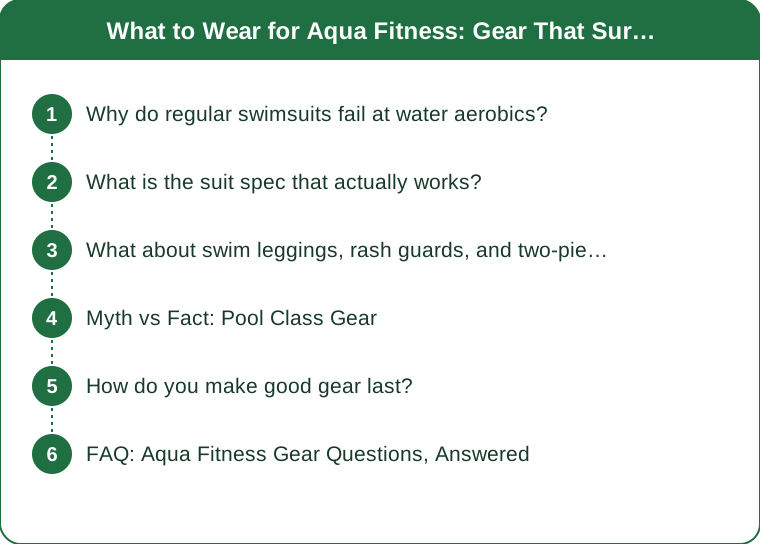
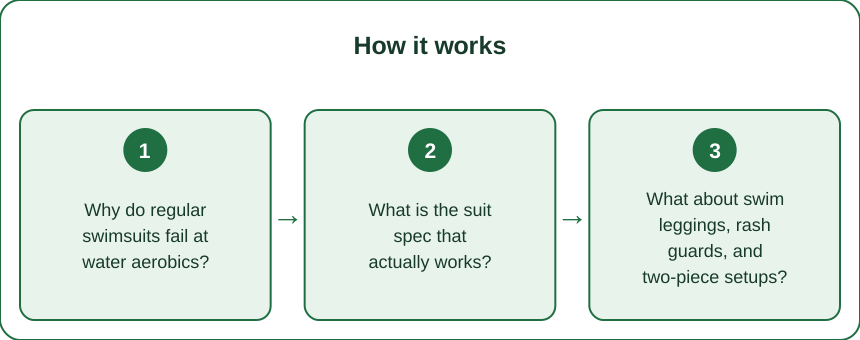
Why do regular swimsuits fail at water aerobics?
Two separate assassins: chemistry and choreography.
Chlorine dismantles elastane. Standard fashion swimsuits run high in elastane (spandex) for that second-skin fit, and chlorine attacks exactly that fiber - breaking down its stretch-and-recover structure with every session. The timeline is fast with weekly-plus exposure: the suit relaxes, the seat goes baggy and translucent, the straps give up. This is not a quality defect; it is the chemistry of the fiber, which is why the fix is a different fiber entirely.
The choreography is nothing like swimming - or sunbathing. A water aerobics class is 45 minutes of jumping jacks, cross-country strides, kicks, and arm sweeps, often against foam-dumbbell resistance. Movements that a lap swimmer’s streamlined stroke never produces:
- Overhead arm work slides thin or crossed fashion straps off shoulders on repeat
- Jumping and jogging test bust support far more than swimming does - water slows you, but the body still moves inside the suit
- High-knee and kick patterns ride up leg openings that were cut for lounging
- Buoyancy itself lifts loose fabric away from the body; anything not anchored floats
So the aqua-fitness suit is closer in mission to a sports bra plus leggings than to beachwear: it has one job - stay exactly where it was put while every limb does something different - and the features that accomplish that are specific and checkable, which is the next section.
What is the suit spec that actually works?
Five features, in order of importance:
1. Chlorine-resistant fabric - the non-negotiable. Look for 100 percent polyester or polyester-PBT blends, often labeled chlorine-proof, chlorine-resistant, or endurance fabric. These fibers shrug off pool chemistry and routinely outlast elastane-heavy suits several times over. The trade: slightly less stretch and a more athletic feel - which for this use is a feature.
2. Wide, fixed straps - ideally a racerback or crossback. Wide straps spread load and stay put through overhead work; racer and cross constructions physically cannot slide off the shoulder. Skip ties, halters, and anything adjustable-by-flimsy-slider.
3. Real bust support. A shelf bra with elastic underband at minimum; fuller busts should look for suits listing cup sizing or power-mesh lining, or plan the two-piece route below. The jump test in the fitting room - yes, actually jump - answers this in three seconds.
4. A moderate-to-higher neckline and secured back. Scoop-but-not-plunging front, and a back that is either high or strapped - deep scoop backs gape and shift under water resistance.
5. Leg openings that grip. A slightly higher-cut athletic leg with firm elastic, or boyleg-style shorts, both hold through kick series. The decorative low-cut leg is the one that rides.
Fit note: sport suits should be genuinely snug on land - water loosens everything slightly, and pool chemistry will relax it further over its life. If it feels politely comfortable in the changing room, consider the size down.
What about swim leggings, rash guards, and two-piece setups?
Completely standard in aqua classes now, and the right answer for several situations:
Swim leggings - leggings cut from swim-grade chlorine-resistant fabric - solve four problems at once: sun protection in outdoor pools (most carry UPF 50), warmth in cool water where classes run long, coverage preference for anyone who wants it, and thigh chafe elimination. They should fit like compression leggings, snug everywhere with a secure high waist - loose fabric drags in water and adds real resistance to every kick. Note they are their own garment: regular gym leggings in a pool means cotton-blend sag and chlorine-shredded elastane within weeks, so buy swim-specific.
Rash guards and swim tops bring the same benefits up top - a fitted short- or long-sleeve swim shirt over a supportive suit or swim bra is the outdoor-class uniform in sunny states, and the long-sleeve version doubles as warmth in chilly indoor pools.
The two-piece athletic route - a high-support swim bra or crop top with high-waisted swim bottoms or leggings - is often the best answer for fuller busts (real bra engineering instead of a shelf) and for anyone who struggles with one-piece torso lengths. The rule that makes it work: both pieces fitted and overlapping - a high waist meeting a longline top - so no gap opens mid-jack.
What earns retirement from class: string anything, bandeaus, swim dresses with floaty skirts (they billow and tangle in leg work), and board shorts, whose loose fabric turns every kick into a drag exercise you did not order.

Myth vs Fact: Pool Class Gear
Myth: Water shoes are for people worried about looking silly. Fact: They are arguably the most functional item in class. Pool floors are slick, and aqua choreography is jumping and pivoting on that surface; a thin-soled water shoe adds grip for push-off, cushions the jumping, and protects soles from rough pool bottoms. Instructors overwhelmingly wear them. Look for drainage, a snug fit that will not float off, and a genuinely grippy outsole.
Myth: A swim cap is pointless if your head stays above water. Fact: Optional, but splash plus chlorine plus 45 minutes reaches your hair regardless. A cap or a simple bun-plus-rinse routine both work; the real rule is rinsing hair after class - and rinsing your body before it, which pools require and which meaningfully reduces the chlorine byproducts everyone shares.
Myth: Any sports bra can double as a swim top. Fact: One class, fine, in an emergency. Regularly, no - gym fabrics absorb water, go heavy and saggy mid-class, and their elastane dies fast in chlorine. Swim-specific fabric is the entire difference.
Myth: Goggles are silly for water aerobics. Fact: Mostly unnecessary - your face rarely submerges - but anyone in the front row of an enthusiastic class knows the splash is real. Personal call, no judgment either way.
Myth: The suit that fits at the store will fit all year. Fact: Even chlorine-resistant suits relax modestly over a season of weekly classes, and elastane suits dramatically. Buy snug, and treat a suit that has gone quietly loose as retired from class duty - it can finish its career on vacation.
How do you make good gear last?
Pool chemistry never sleeps, but the care routine that fights it takes four minutes:
Rinse immediately, every time. Cool tap water over suit, leggings, and shoes within minutes of leaving the pool removes most of the chlorine before it can keep working on the fibers in your bag. The post-class shower with the suit on counts perfectly.
Hand wash properly once a week - mild soap, cool water, gentle squeeze. No machine, whose agitation ages elastic; no fabric softener, ever, which coats technical fibers.
Dry in shade, flat or draped - never wrung, never on a radiator, never in the dryer, never in direct sun. Heat and UV finish what chlorine starts. Rolling the suit in a towel and pressing gets most water out without twisting the fibers.
Rotate two suits if you attend twice a week or more. Elastic recovers between wears like muscle recovers between workouts; alternating doubles the calendar life of both, and you are never stuffing a damp suit into a bag at 8am.
Transport wet gear in a mesh bag, not sealed plastic - trapped chlorinated moisture is the fastest aging environment there is, plus the smell.
Retirement signals: a seat you can see light through when stretched, straps that need adjusting mid-class, waistbands that fold over on leggings. Chlorine-resistant gear on this routine typically delivers seasons, not weeks - which turns the slightly higher sticker price into the cheapest cost-per-class in your gym life.
FAQ: Aqua Fitness Gear Questions, Answered
Do I really need a special suit for my first class?
No - wear whatever swimsuit you own, secured as well as it allows, and go. The upgrade matters once you are attending regularly; the first class only needs you in the water. If you buy one thing before committing, make it water shoes, which improve class one immediately.
What do most women actually wear to water aerobics?
The honest census of a typical class: sport one-pieces lead, followed by swim-leggings-plus-top combinations and high-waisted two-piece athletic sets, with rash guards common outdoors. Coverage spans everything, nobody is grading, and instructors care about exactly one thing - that nothing you wear needs mid-class rescue.
Are swim leggings hot or heavy in the water?
In the water they are neutral to pleasant - swim fabric holds negligible water and the coverage often reads as warmth in cool pools. The heaviness people fear belongs to regular cotton-blend leggings, which do soak and drag. Out of the pool, swim leggings also dry dramatically faster.
How should aqua shoes fit?
Snug like a sock, not roomy like a sneaker - water finds loose shoes and tries to float them off mid-kick. You want covered toes, drainage ports, and grip you can feel when you pivot. Sizes often run generous, so many people size down a half.
TL;DR:
- Chlorine destroys elastane - buy polyester or PBT chlorine-resistant fabric and get seasons instead of weeks
- The suit spec: wide racer or cross straps, real bust support, secured back, grippy athletic leg openings, snug on land
- Swim leggings and rash guards are standard class wear - UPF, warmth, coverage, and chafe control in one
- Water shoes are the sleeper essential: grip for pivots, cushion for jumps, worn by the instructors themselves
- Rinse immediately, dry in shade, rotate two suits, transport in mesh - the four-minute routine that doubles gear life
Aqua fitness is the rare workout where the gear question has a complete, checkable answer. Get the fiber right, the straps wide, and the shoes grippy, and the pool stops eating your wardrobe - leaving you free to focus on the part where the water fights back.
See It in Motion
Seen here: Racerback Tank Top - White — shop similar styles on bubblelime.com
Keep Reading
This article is for general informational purposes only and is not medical advice. Always consult a qualified health professional for guidance specific to you.