The Complete Aqua Fitness Progression: From First Class to Advanced Training
Quick Answer: Aqua fitness progresses through four real stages — orientation, resistance building, intensity intervals, and advanced plyometric/equipment work — and most people stall at stage one for years simply because no one tells them stage two exists.
Aqua fitness gets dismissed by some as low-intensity or “just for beginners,” but that reputation exists because most classes are taught at a single beginner level indefinitely. There’s a real four-stage progression underneath, and most participants never get shown the second half of it.

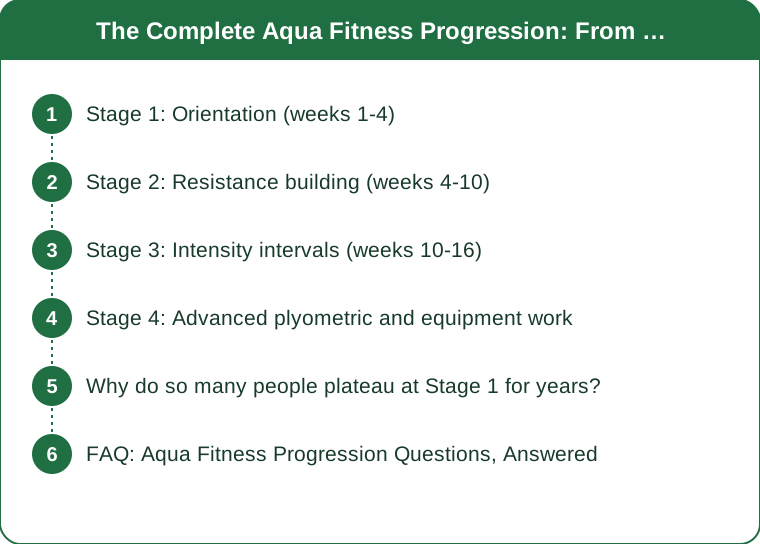
Stage 1: Orientation (weeks 1-4)
This stage is about water comfort and basic movement patterns: walking and jogging in water, basic arm sweeps, and getting comfortable with water resistance at chest depth. The goal here isn’t fitness gain yet — it’s building the movement vocabulary that later stages build on.
Most people can move past this stage within 3-4 sessions if they focus on proper form (upright posture, controlled movements) rather than speed.
Stage 2: Resistance building (weeks 4-10)
Once basic movements feel comfortable, adding resistance equipment — webbed gloves, foam dumbbells, ankle buoys — meaningfully increases the workload without any joint impact. This stage should also introduce deeper water work (near chest-to-shoulder depth) where buoyancy assist decreases and your core has to work harder for stability.
A realistic marker for readiness to progress: comfortably completing 30-40 minutes of resistance-equipment work without needing to stop and rest.
Stage 3: Intensity intervals (weeks 10-16)
This is where aqua fitness starts training cardiovascular capacity seriously: structured intervals of high-effort movement (fast cross-country ski motion, tuck jumps, sprint kicks) alternated with active recovery. Water’s resistance means these intervals feel different than land-based HIIT — heart rate often runs lower for the same perceived effort due to water pressure’s effect on circulation, so effort level, not heart rate alone, should guide intensity here.
A good structure: 30 seconds high effort, 30-60 seconds active recovery, repeated 8-12 times within a session.

Stage 4: Advanced plyometric and equipment work
Advanced aqua fitness incorporates aqua bikes, resistance paddles, suspended deep-water plyometrics (tuck jumps and mountain climbers with a flotation belt in deep water), and complex combination movements requiring real coordination. This stage genuinely rivals land-based HIIT for cardiovascular demand while remaining low-impact — it’s a legitimate advanced training modality, not a lesser substitute for land workouts.
Most participants who reach this stage report it took 4-6 months of consistent 2-3x weekly attendance, though timelines vary widely with starting fitness level.
Why do so many people plateau at Stage 1 for years?
Because most group aqua classes are structured for the lowest common denominator in the room, and instructors rarely flag when an individual is ready to progress. If your class has felt the same for months, that’s not a sign aqua fitness has capped out for you — it’s a sign to ask your instructor about advanced formats, or add equipment and interval structure yourself.
FAQ: Aqua Fitness Progression Questions, Answered
How long does it take to reach advanced aqua fitness?
Most consistent participants (2-3x weekly) move through all four stages within 4-6 months, though prior fitness level and how much individual attention a class offers both affect the timeline significantly.
Is aqua fitness ever as intense as land-based HIIT?
Advanced stage 3-4 aqua fitness with intervals and equipment can match or exceed land-based HIIT in cardiovascular demand, while staying low-impact — it’s a common misconception that water fitness has a hard intensity ceiling.
Do I need special equipment to progress past beginner aqua fitness?
Some resistance equipment (webbed gloves, ankle buoys) meaningfully speeds progression, but bodyweight-only deep water work and interval structuring alone can also move you through most of the progression without buying anything.
TL;DR:
- Stage 1 (orientation): comfort and movement basics, weeks 1-4
- Stage 2 (resistance): equipment and deeper water, weeks 4-10
- Stage 3 (intervals): structured high-effort cardio work, weeks 10-16
- Stage 4 (advanced): plyometrics and equipment combos, 4-6 months in
- Most people plateau at Stage 1 for years simply from lack of guidance — ask your instructor or self-progress
Aqua fitness has a real advanced tier — most people just never get shown the map to it.
Keep Reading
This article is for general informational purposes only and is not medical advice. Always consult a qualified health professional for guidance specific to you.