The Complete Guide to Water Depth and Aqua Fitness Intensity: Why Where You Stand Changes Everything
Quick Answer: Water depth changes both resistance and impact independently — shallower water (waist-deep) keeps more body weight loaded for impact-based work, while deeper water (chest-to-shoulder) removes impact almost entirely and shifts effort toward resistance and buoyancy control, so matching depth to your actual goal matters as much as the exercises themselves.
Most people pick a spot in the pool once, at the start of class, and stay there the whole session regardless of what’s being taught. That single choice quietly changes the entire workout, and most aqua fitness participants have never been told why.

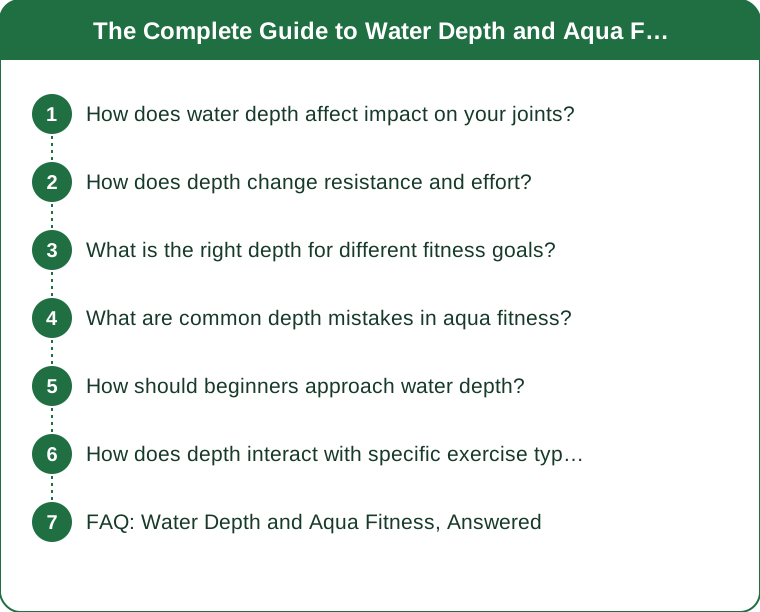
How does water depth affect impact on your joints?
In water up to your waist, a meaningful portion of your body weight is still loaded through your joints — you get some impact benefit (useful for bone density work) alongside some cushioning.
As water rises past your hips toward your chest, buoyancy takes over more of your body weight, and impact on knees, hips, and ankles drops sharply. By shoulder-depth, most people are nearly weightless, which is why deep-water classes are often recommended for people managing joint pain or recovering from injury.
This means the same jumping-jack style movement is a genuinely different exercise depending on where in the pool you’re doing it — not a minor variation, but a real difference in what’s being trained.
How does depth change resistance and effort?
Water resistance increases with the speed of movement through it, and deeper water gives you more surface area of your limbs working against that resistance, particularly for arm movements performed at shoulder height or below the surface.
At the same time, deeper water requires more core and stabilizer engagement just to stay balanced, since you can no longer rely on the pool floor for as much stability. This is part of why deep-water aqua fitness, despite looking gentler, often produces noticeably more full-body fatigue than shallow-water classes covering similar movements.
The practical implication: if you feel like a shallow class isn’t challenging enough, moving even a foot deeper for the same movements can meaningfully increase difficulty without changing the exercise itself.
What is the right depth for different fitness goals?
Weight-bearing and bone health focus: waist-to-hip depth, where enough body weight remains loaded to provide a bone-loading stimulus while water still reduces peak impact forces compared to land.
Joint pain, injury recovery, or high-impact sensitivity: chest-to-shoulder depth, where buoyancy removes the majority of joint loading, letting you move through fuller ranges of motion with less pain.
Cardiovascular and full-body conditioning: a mix, often navel-to-chest depth, which balances meaningful resistance against manageable stability demands — this is the most common ‘default’ depth used in general aqua fitness classes for good reason.

What are common depth mistakes in aqua fitness?
Standing in water that’s too shallow for your goal is the most frequent mistake — many people gravitate toward waist-deep water because it feels more stable, even when their actual goal (like joint pain relief) calls for deeper water.
The opposite mistake also happens: beginners in deep water before building basic stability and breath control there can struggle more with balance than with the actual exercise, which undermines confidence unnecessarily. Building comfort in progressively deeper water over a few sessions solves this better than avoiding depth altogether.
A third mistake is treating pool depth as fixed for an entire session when many pools have a gradual slope — deliberately using that slope to shift depth between exercise blocks can let one class serve multiple goals.
How should beginners approach water depth?
Start at a depth where your feet stay solidly on the pool floor and you feel stable through basic movements — often waist to hip depth for most adults. Spend 2-3 sessions building comfort with balance and breath control there before moving deeper.
Once basic movements feel controlled, test one exercise a session at a slightly deeper level, noting how effort and balance demands change. This gradual approach builds the body awareness needed to use depth deliberately rather than defaulting to whatever feels easiest.
How does depth interact with specific exercise types?
Jogging and jumping-style movements are the most depth-sensitive — impact drops dramatically as depth increases, making these excellent ‘depth dial’ exercises to feel the difference directly.
Arm-focused movements like presses and sweeps become more resistance-heavy in deeper water, since more of the limb works against water resistance rather than partially breaking the surface.
Balance and core work is arguably most affected by depth of all categories — a plank-style hold that’s manageable in shallow water can become a genuine core challenge in chest-deep water purely from the reduced floor stability, without changing the movement itself.
FAQ: Water Depth and Aqua Fitness, Answered
Is deeper water always a harder workout?
Not necessarily harder overall — it’s differently demanding. Impact and joint loading drop, but resistance and stability demands often rise, so ‘harder’ depends on what you’re measuring.
What depth is best for beginners?
Waist-to-hip depth for the first several sessions, building comfort with balance before progressing to deeper water.
Can I get a good workout in shallow water only?
Yes — shallow water still provides real resistance and, for weight-bearing goals, is actually preferable to deep water. Depth should match your goal, not a general assumption that deeper is better.
TL;DR:
- Shallower water keeps more impact loaded on joints; deeper water shifts toward buoyancy and resistance
- Deeper water often demands more core and stability work despite feeling gentler
- Match depth to your goal: waist-deep for bone loading, chest-deep for joint relief, a mix for general conditioning
- Build comfort gradually in deeper water rather than jumping straight in
This is general information, not medical advice — check with a professional if you’re managing a specific joint condition or injury.
Keep Reading
This article is for general informational purposes only and is not medical advice. Always consult a qualified health professional for guidance specific to you.