The Complete Guide to Understanding Water Resistance Levels in Aqua Fitness
Quick Answer: Water resistance in aqua fitness scales with movement speed, water depth, surface area of the moving limb, and any added equipment (webbed gloves, water weights, noodles) — meaning you can precisely control workout intensity without ever adding traditional weight. Understanding these four variables lets you build a genuinely progressive aqua fitness program.
On land, increasing workout intensity almost always means adding weight. In the water, intensity is controlled by an entirely different set of variables — and most people using a pool for fitness never learn to manipulate them intentionally, leaving real progression on the table.

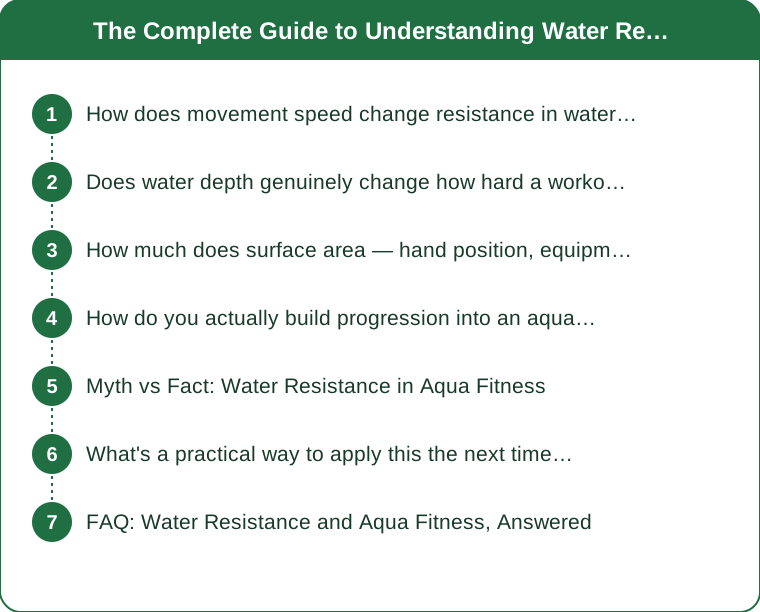
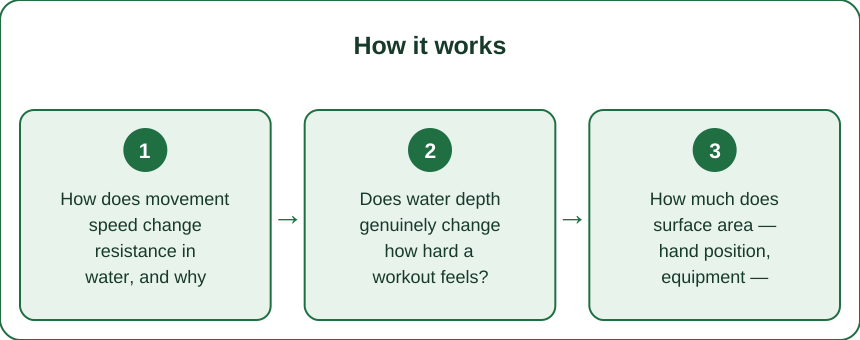
How does movement speed change resistance in water, and why does it matter so much?
Water resistance increases roughly with the square of your movement speed — meaning doubling your speed through the water doesn’t just double the resistance, it can increase it four-fold. This is fundamentally different from how resistance works with free weights on land, where resistance stays constant regardless of how fast you move.
This relationship is why aqua fitness instructors emphasize movement speed as a primary intensity lever: slowing down dramatically reduces the workload, while a moderate speed increase creates a disproportionately larger challenge. Understanding this lets you fine-tune intensity mid-workout without changing exercises or equipment at all — simply speeding up a punching or kicking motion can turn a moderate exercise into a genuinely challenging one.
For beginners, this also means starting slower than feels intuitive is the safer approach, since resistance builds quickly as speed increases, and a fast start can be more taxing than expected.
Does water depth genuinely change how hard a workout feels?
Yes, substantially. Chest-deep water reduces joint-loading impact by roughly 75% compared to land, while also supporting more of your body weight, which changes both how hard your muscles have to work and how much buoyancy assists your movement. Waist-deep water offers less buoyancy support and more resistance from limbs moving through water at a wider range, while shoulder-deep water maximizes buoyancy support and reduces the resistance surface area your legs create during lower-body exercises.
This means the same exercise performed at different depths in the same pool session produces meaningfully different training effects. Many aqua fitness classes deliberately vary depth throughout a session — moving to shallower water for higher-impact-feeling cardio work and deeper water for more buoyancy-supported, joint-friendly resistance work — precisely because of this depth-resistance relationship.
Understanding your own optimal depth also matters for injury recovery: someone rehabbing a joint issue often benefits from deeper water’s greater buoyancy support, while someone building bone density benefits more from the added impact of shallower water.
How much does surface area — hand position, equipment — actually change the workout?
Surface area is one of the most underused resistance variables in aqua fitness. A flat, open palm pushing through water creates significantly more resistance than a closed fist or a hand sliced edge-first through the water, which means you can adjust intensity mid-exercise just by changing hand position, without any equipment at all.
Adding equipment amplifies this same principle: webbed gloves and water-resistant paddles increase surface area (and therefore resistance) for upper body work, while fins increase resistance and propulsion for lower body and kicking exercises. Water weights and noodles work differently depending on whether you’re pushing them down into the water (working against buoyancy) or moving them horizontally (working against drag resistance).
This layered system — speed, depth, surface area, and equipment — means a single aqua fitness routine can be scaled from very gentle to quite demanding using the exact same pool and exercises, just by adjusting these four variables deliberately rather than assuming water fitness has one fixed intensity.

How do you actually build progression into an aqua fitness routine using these variables?
Progression in aqua fitness doesn’t have to mean adding heavier equipment — it can mean systematically increasing speed, reducing depth slightly for more resistance surface, or adding hand-surface-area equipment over successive weeks, the same way you’d add weight plates on land. A simple progression might start with slow, open-palm movements in shoulder-deep water and progress over several weeks to faster movements in waist-deep water with webbed gloves.
Tracking progression is less intuitive in water than counting weight plates, so many aqua fitness instructors recommend tracking either the number of reps completed at a consistent speed and depth, or simply noting subjective effort level (a 1-10 scale) at a given speed and depth combination over time, watching that number decrease as fitness improves at the same settings.
This systematic approach also matters for injury rehabilitation contexts, where a physical therapist may prescribe very specific depth and speed combinations to control the exact load on a healing joint — understanding these variables makes it possible to follow that guidance precisely rather than approximating it.
Myth vs Fact: Water Resistance in Aqua Fitness
Myth: Water fitness is inherently low-intensity compared to land workouts. Fact: With deliberate speed and surface area manipulation, aqua fitness can match or exceed the intensity of many land-based cardio and resistance workouts, while remaining lower-impact on joints.
Myth: You need water weights or equipment to get real resistance. Fact: Hand and body position alone create meaningful, adjustable resistance — equipment adds to this but isn’t required to build a genuinely challenging workout.
Myth: Deeper water always means a harder workout. Fact: Deeper water increases buoyancy support, which can actually reduce resistance for certain movements even as it changes the type of challenge involved.
What’s a practical way to apply this the next time you’re in the pool?
Pick one familiar exercise — a simple front kick or arm punch through the water — and deliberately run it through the variables: slow and open-palm, then fast and open-palm, then slow with a closed fist, then fast with a closed fist. Noticing the clear difference in perceived effort across these four combinations, using the exact same exercise, is the fastest way to internalize how much control you actually have over intensity without changing the movement itself.
From there, building a session that intentionally varies depth (moving between waist-deep and chest-deep sections of the pool, if available) and speed throughout gives you a genuinely progressive, varied workout using tools that are already in the pool — no equipment purchase required to get started.
FAQ: Water Resistance and Aqua Fitness, Answered
Do I need special equipment to make aqua fitness challenging?
No — speed and hand position alone create substantial, adjustable resistance. Equipment like webbed gloves and water weights add options but aren’t required to build a demanding workout.
Is aqua fitness resistance training as effective as weight training on land for building strength?
Research generally shows aqua resistance training can produce meaningful strength gains, particularly for populations where joint-loading is a concern, though very advanced strength goals may still benefit from some land-based resistance work too.
How do I know if I’m working hard enough in the water if I can’t easily track weight?
A subjective effort scale (1-10) or simply noting whether you can hold a conversation during the exercise (harder efforts make this difficult) are practical ways to gauge intensity without a weight number to reference.
TL;DR:
- Resistance scales roughly with the square of movement speed — small speed increases create disproportionately larger challenge
- Water depth changes both buoyancy support and resistance, with real implications for joint-friendly training
- Hand and body surface area change resistance even without equipment
- Progression comes from deliberately increasing speed, adjusting depth, or adding surface-area equipment over time
Aqua fitness isn’t a fixed-intensity activity — understanding these four variables turns the same pool session into a genuinely progressive, scalable workout.
Keep Reading
This article is for general informational purposes only and is not medical advice. Always consult a qualified health professional for guidance specific to you.