Deep Water Running: The Complete Guide to Training Without Impact
Quick Answer: Deep water running is running form performed in water too deep to touch, usually with a flotation belt. It produces no impact at all, which makes it the standard cross-training option for injured runners and for anyone who needs cardiovascular work without loading joints. Done with correct form and structured intervals, it maintains running fitness remarkably well - done as an aimless bob in the deep end, it does very little.

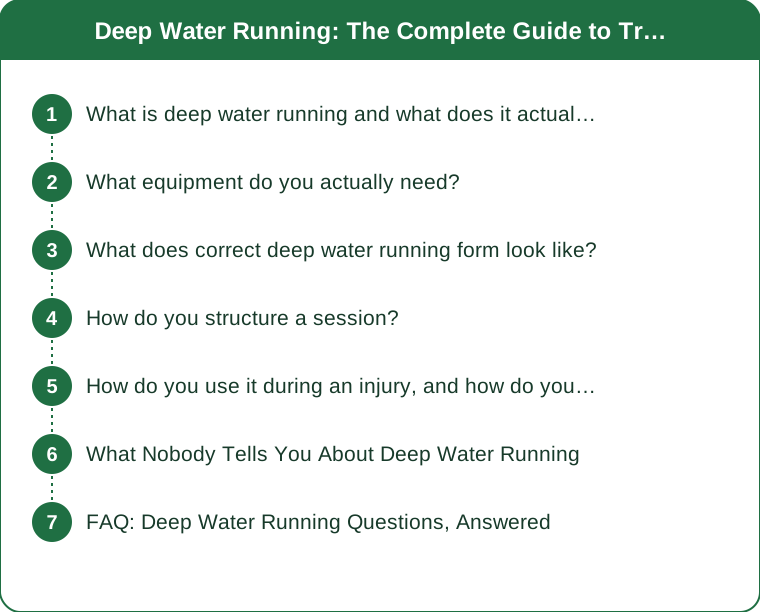
What is deep water running and what does it actually do?
It is running mechanics performed vertically in water deep enough that your feet never contact the bottom.
Most people use a flotation belt around the waist, which keeps you suspended at roughly shoulder depth with your head comfortably above water. Some experienced practitioners go beltless, which is significantly harder and mostly unnecessary.
What it provides:
- Zero impact. No ground reaction force at all, which is why it’s used during stress fracture recovery, after joint surgery, and for anyone managing arthritis.
- A real cardiovascular stimulus. Studies of deep water running consistently find it can maintain aerobic fitness in trained runners over multi-week periods when programmed with appropriate intensity.
- Resistance in every direction. Water resists movement on both the drive and the recovery phase, which loads the hip flexors in a way land running doesn’t.
What it doesn’t provide:
- Impact loading for bone and tendon. This is the point for injured athletes, and it’s the limitation on return. Bone and tendon adapt to load, and water provides none.
- Eccentric loading. Land running involves a substantial braking and elastic return phase. Water running has essentially none, which is why the first land run after a water block can produce unexpected soreness.
The honest framing: it maintains the engine while the chassis heals. It doesn’t maintain the chassis.
What equipment do you actually need?
Very little, and the belt is the only item that genuinely matters.
A flotation belt is the core piece. It should sit at the waist, snug enough that it doesn’t ride up under your arms, and it should keep your shoulders at or just above water level. Belts vary in buoyancy; if you find yourself floating too high, your form will collapse into a lean, and if you’re sinking, you’ll fight to stay up rather than run.
A pool with genuinely deep water. You need enough depth that your feet cannot touch when running with normal knee lift - usually a minimum of about 2 metres. A pool that’s 1.4m deep won’t work, because you’ll unconsciously push off the bottom.
Optional and useful: a waterproof watch or a poolside clock for interval timing, and resistance gloves if you want to increase upper body demand. Ankle floats and hand paddles exist but complicate form for beginners.
Not needed: special shoes, wetsuits, or any of the specialised gear marketed for it.
A practical note on pools: lap swimmers and deep water runners occupy space differently, and most pools have a preferred area for this. Ask on your first visit rather than working it out by trial and error - it saves an awkward forty minutes.
What does correct deep water running form look like?
Form matters more here than in almost any other cross-training modality, because bad form turns it into a very expensive way to bob.
Posture: vertical, with a very slight forward lean. The most common error is leaning forward significantly, which turns the movement into something closer to water cycling and drops the intensity substantially. Imagine a line from ear through shoulder through hip.
Knee drive: high, to roughly 60-80 degrees of hip flexion. Deliberate and pronounced. This is the primary driver of intensity.
Lower leg: extends forward then sweeps back, mimicking the running stride rather than cycling in a circle. Cycling motion is the single most common technical fault, and it changes which muscles work and how hard.
Ankles: relatively dorsiflexed - toes pulled slightly up - during the drive, then relaxed on recovery.
Arms: driving forward and back, not across the body. Elbows around 90 degrees, hands lightly cupped or in loose fists. Arm drive contributes meaningfully to intensity here, more than it does on land.
Cadence: 150-180 strides per minute at moderate to hard efforts. This is lower than land running cadence because water resistance slows the cycle, and it’s the most useful objective form check available. Count your strides for 15 seconds and multiply by four - if you’re under 140 at a hard effort, your form has probably collapsed into a cycle.
Head and gaze: looking forward, not down. Looking down tips the whole body into a lean.

How do you structure a session?
Structure is what separates useful deep water running from wasted time, and this is where most people fail.
The core problem: perceived effort scales differently in water. Heart rate at a given effort tends to run lower in deep water immersion than on land - commonly around 8-15 beats per minute lower at comparable efforts - because of hydrostatic pressure and the effect of immersion on cardiovascular function. If you train to your usual land heart rate targets, you will under-train significantly.
Use cadence and perceived effort instead, and expect the numbers to look different.
A beginner session (30 minutes):
- 5 minutes easy, finding the form and belt position
- 8 x 1 minute at moderate effort with 1 minute easy between
- 5 minutes easy
An intermediate interval session (45 minutes):
- 10 minutes easy warm-up with 4 x 20 second pickups
- 6 x 3 minutes hard, 90 seconds easy recovery
- 8 minutes easy cool-down
A long steady session (50-60 minutes):
Sustained moderate effort with cadence held at 150-160. This is the least engaging option and the most useful for aerobic maintenance during an injury layoff.
Why intervals dominate here: continuous deep water running is mentally hard to sustain at a genuine effort, and most people drift down in intensity without noticing. Intervals with clear targets keep the effort honest. Bring something to listen to if the pool allows it - boredom is the real limiter, not fitness.
How do you use it during an injury, and how do you come back?
This is the most common reason people start, and the return is where mistakes happen.
During the layoff: deep water running can carry most of your running volume, converted by time rather than distance. A 45-minute run becomes a 45-minute water session, roughly. Three to five sessions a week maintains aerobic fitness well for most runners, and research on multi-week water running blocks supports maintenance of key performance markers in trained runners.
Get clearance for the specific injury first. Deep water running is non-weight-bearing, which suits most bone and joint injuries, but hip flexor and groin injuries can be aggravated by the resistance on the recovery phase. Which cross-training is appropriate for which injury is a question for the professional treating you. This is general information, not medical advice.
The return to land is where people get hurt again. Water running maintains the cardiovascular system while bone, tendon, and connective tissue detrain from impact. That mismatch means you will feel far fitter than your tissues are prepared for.
A conservative return progression:
- Week 1: walk-run intervals, 1 minute running / 2 minutes walking, 20 minutes total, every other day
- Week 2: 2 minutes running / 1 minute walking, 25 minutes total
- Week 3: 4-5 minute continuous blocks, 30 minutes total
- Week 4 onward: continuous running, adding no more than 10% per week
Keep two water sessions a week during the return. They preserve aerobic volume while land volume stays deliberately low, which is the whole point.
Expect soreness in the first land runs that you didn’t have in the water. Eccentric loading returns abruptly, and calves and quads notice.
What Nobody Tells You About Deep Water Running
You will be colder than you expect. Deep water running is a low-splash, moderately paced activity in water often kept at 27-28C, and you’re not generating the heat you would swimming laps. Many people find they need a slightly warmer pool or a rash vest for longer sessions. Being cold is one of the more common reasons sessions get cut short.
Hip flexors get sore in a way land running doesn’t produce. Water resists the recovery phase of the stride, which loads the hip flexors concentrically in both directions. Expect specific soreness there for the first two weeks, and expect it to settle.
Your form degrades as you fatigue, invisibly. On land, tired form produces obvious feedback. In water, you simply slow the cycle and the effort drops with it. Checking cadence every few minutes during hard intervals is the only reliable guard against this.
Belt position drifts. Belts ride up over a session, which changes your body position and your effort. Reposition it whenever you notice, rather than compensating.
Hydration still matters. Being surrounded by water doesn’t stop you sweating, and you won’t notice that you are. Keep a bottle at the poolside and use it.
It’s genuinely boring for most people. This is the biggest practical obstacle and it deserves a real solution rather than willpower - interval structure, waterproof headphones, or a training partner in the next lane. A brilliant plan you can’t tolerate is worse than a modest one you’ll do.
And it works for far more than injury. Deep water running is a reasonable permanent addition for anyone managing joint issues, adding aerobic volume without adding impact load, or training through a period where their body can’t absorb more pounding. It doesn’t have to be a temporary substitute.
FAQ: Deep Water Running Questions, Answered
Do I need to be a good swimmer?
No. With a flotation belt you stay upright with your head above water and you aren’t swimming. Basic water confidence is enough, and staying in a lane where you can reach the side helps at first.
How does the time compare to running on land?
Most programmes convert roughly minute for minute rather than by distance. Distance is meaningless in deep water; time and effort are what you track.
Why is my heart rate so much lower?
Hydrostatic pressure and immersion effects reduce heart rate at comparable efforts - commonly by 8-15 beats per minute. Use cadence and perceived effort as your primary guides instead.
Can I do this in a shallow pool?
Not properly. If your feet can touch during normal knee drive, you’ll push off the bottom, which reintroduces impact and changes the exercise entirely.
How long can I maintain running fitness this way?
Research on trained runners suggests key markers can be maintained over multi-week blocks with appropriately intense sessions. What detrains is impact tolerance, not the aerobic system.
Is a belt required?
Not strictly, but beltless deep water running is substantially harder and makes correct form much more difficult. Use a belt unless you have a specific reason not to.
TL;DR:
- Running mechanics in deep water with a flotation belt - zero impact, real cardiovascular stimulus
- Maintains aerobic fitness well; does nothing for bone and tendon impact tolerance
- Form essentials: vertical posture, high knee drive, stride not cycle, cadence 150-180
- Heart rate runs 8-15 bpm lower in water - use cadence and effort, not land HR zones
- Intervals beat continuous work because effort drifts down invisibly
- Return to land conservatively: walk-run intervals for two weeks, 10% weekly increases after
It keeps the engine running while everything else heals. Just don’t mistake the engine for the whole vehicle.
Keep Reading
This article is for general informational purposes only and is not medical advice. Always consult a qualified health professional for guidance specific to you.