The Complete Guide to Moving Your Water Workouts Indoors When the Outdoor Pool Closes
Quick Answer: The outdoor-to-indoor transition changes five things at once: water temperature (indoor pools typically run warmer, which raises perceived exertion), air temperature and humidity, water depth and lane layout, class schedules and crowd levels, and chlorine exposure. Plan for a two-week adjustment, book your indoor slot before the outdoor pool closes rather than after, expect your usual workout to feel harder in warmer water, and build a chlorine-management routine for hair and skin now that you are indoors five days a week. Most people who lose the habit in September lose it to logistics, not motivation.
Every year the same thing happens. The outdoor pool closes after the first weekend in September, the plan is to find something indoors next week, and by October the swimsuit is dry. This guide is the version that survives the transition.
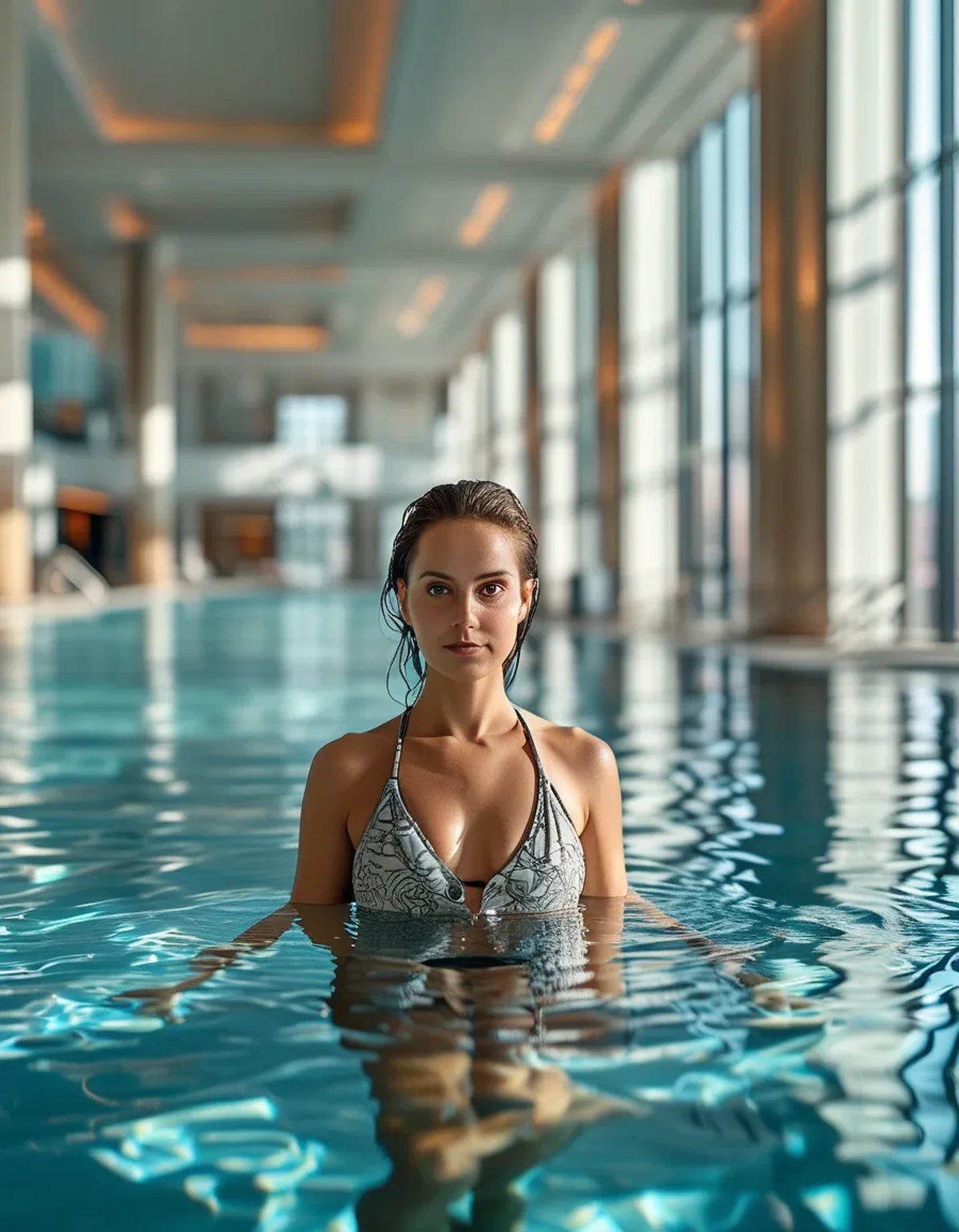
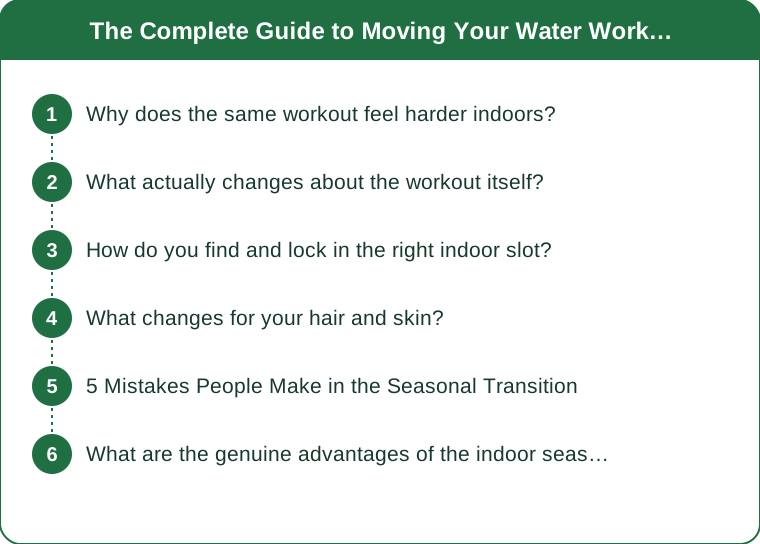
Why does the same workout feel harder indoors?
Water temperature is the biggest single variable, and it usually moves in the direction that makes work feel harder. Outdoor pools in late summer often sit in the low 80s Fahrenheit or cooler, while indoor pools programmed for general use and aqua fitness classes commonly run warmer, frequently in the mid to high 80s. Therapeutic and warm-water pools can be warmer still.
Warmer water reduces your body’s ability to shed heat. Water conducts heat away from the body far more efficiently than air, which is exactly why cool water feels so effortless during hard work. Raise the water temperature a few degrees and that cooling advantage shrinks. Your heart rate climbs faster, you feel warmer sooner, and a workout you have done fifty times suddenly feels like a different session.
The air above the water changes too. Indoor pool halls are humid by design, often held at high relative humidity to reduce evaporation and condensation. Between sets, when your shoulders are out of the water, you get almost no evaporative cooling from that humid air. Outdoors, a light breeze across wet skin did a lot of quiet work you never noticed.
Perceived exertion rises before actual intensity does. This is the part that catches people out. You are not less fit than you were in August - you are working in a less forgiving thermal environment. If you judge yourself by how the session feels, you will conclude you have lost fitness in ten days, which is both untrue and demoralizing.
Give it a genuine two weeks. Heat acclimatization is real and reasonably quick. The first three or four indoor sessions are the hardest; by the second week most people report the difference has largely evened out. Knowing this in advance is most of the battle, because the alternative interpretation - that you have suddenly become unfit - is the one that ends habits.
Practical adjustments for the first two weeks: shorten the session by about a quarter, take deliberate breaks at the wall rather than pushing through, keep a water bottle on the deck and actually drink from it, and lower the intensity target rather than the frequency. Frequency is what preserves the habit; intensity can come back on its own schedule.
What actually changes about the workout itself?
Depth is the variable that changes your exercise selection most. Outdoor pools often have a broad shallow area ideal for standing aqua fitness. Indoor lap pools frequently have a more uniform depth, sometimes with no genuinely shallow end at all. If your routine was built on chest-deep standing work, a uniform four-and-a-half-foot pool changes your leverage on every movement, and a deep pool changes them entirely.
Measure the depth in your first session and adjust honestly. Water at nipple height offloads roughly 70 to 75 percent of body weight; water at waist height offloads far less and increases the impact on joints. If you moved to a shallower pool for joint relief reasons, you have lost some of the benefit and should reduce jumping and bounding movements accordingly.
Lane layout compresses your space. Outdoor pools often allow free movement across a wide area. Indoor pools are usually roped into lanes with an aqua fitness area squeezed to one end. Lateral travel movements - side steps, cross-country skis with travel, jogging widths - may not fit. Convert them to stationary versions with a deliberate emphasis on range and tempo, which preserves most of the stimulus.
Equipment availability differs. Many outdoor facilities keep a big bin of noodles and dumbbells poolside all summer, then lock it away. Indoor facilities may charge for equipment, restrict it to instructor-led classes, or have none at all. Find this out before your first session and buy your own set of foam dumbbells if needed - they are inexpensive, they travel, and they eliminate the dependency entirely.
Deep-water running becomes more available, not less. If your indoor pool has genuine deep water and allows belts, this is the one thing that usually improves in the transition. Deep-water running is the highest-intensity, lowest-impact option in the building and it is a genuinely excellent winter base-building tool for runners and anyone managing joint load.
And the water chemistry may feel different. Indoor pools handle chloramines differently than outdoor pools, where sunlight and open air help. That distinctive strong pool smell is chloramines rather than chlorine itself, and a strong smell usually indicates a ventilation issue rather than an over-chlorinated pool. If a facility consistently smells strong and makes your eyes and throat burn, that is legitimate information about the facility.
How do you find and lock in the right indoor slot?
Do this in August, not September. The single biggest predictor of whether an aqua fitness habit survives the seasonal transition is whether the replacement was booked before the gap appeared. A two-week gap becomes a two-month gap with remarkable reliability.
Start with facility type rather than proximity. Community and municipal centers usually have the warmest water and the most aqua fitness programming. Hospital and rehabilitation pools run warmest and often have the best-trained instructors for joint-related needs, though membership may require a referral or carry restrictions. Private gyms and hotel pools tend toward smaller, cooler pools with less programming. University pools are cheap and excellent if you can access them, but the term schedule creates its own closures.
Ask three specific questions when you call. What temperature is the pool held at? What is the depth range in the area used for aqua fitness? And what does the class schedule look like specifically in December and January, not just this month? That third question catches facilities that quietly cut programming in the winter.
Visit at the exact time you intend to train. A pool that is serene at 2pm on a Tuesday is a different building at 6pm on a Wednesday. Crowd level in an indoor pool matters far more than outdoors because the space is finite.
Consider going to two facilities rather than one. One with good class programming for two days a week, one closer to home for independent sessions. This is more resilient than a single membership, because the most common reason for stopping is a schedule change at one facility.
Watch the pricing structure carefully. Many facilities sell annual memberships in September at exactly the moment demand peaks. A month-to-month or class-pack option for the first six weeks lets you confirm the fit before committing, and the small premium is worth it.
And book the sessions into your calendar as appointments. Outdoor pool season had its own natural rhythm; indoor training has to be scheduled deliberately or it competes with everything else in a dark, busy autumn evening.
What changes for your hair and skin?
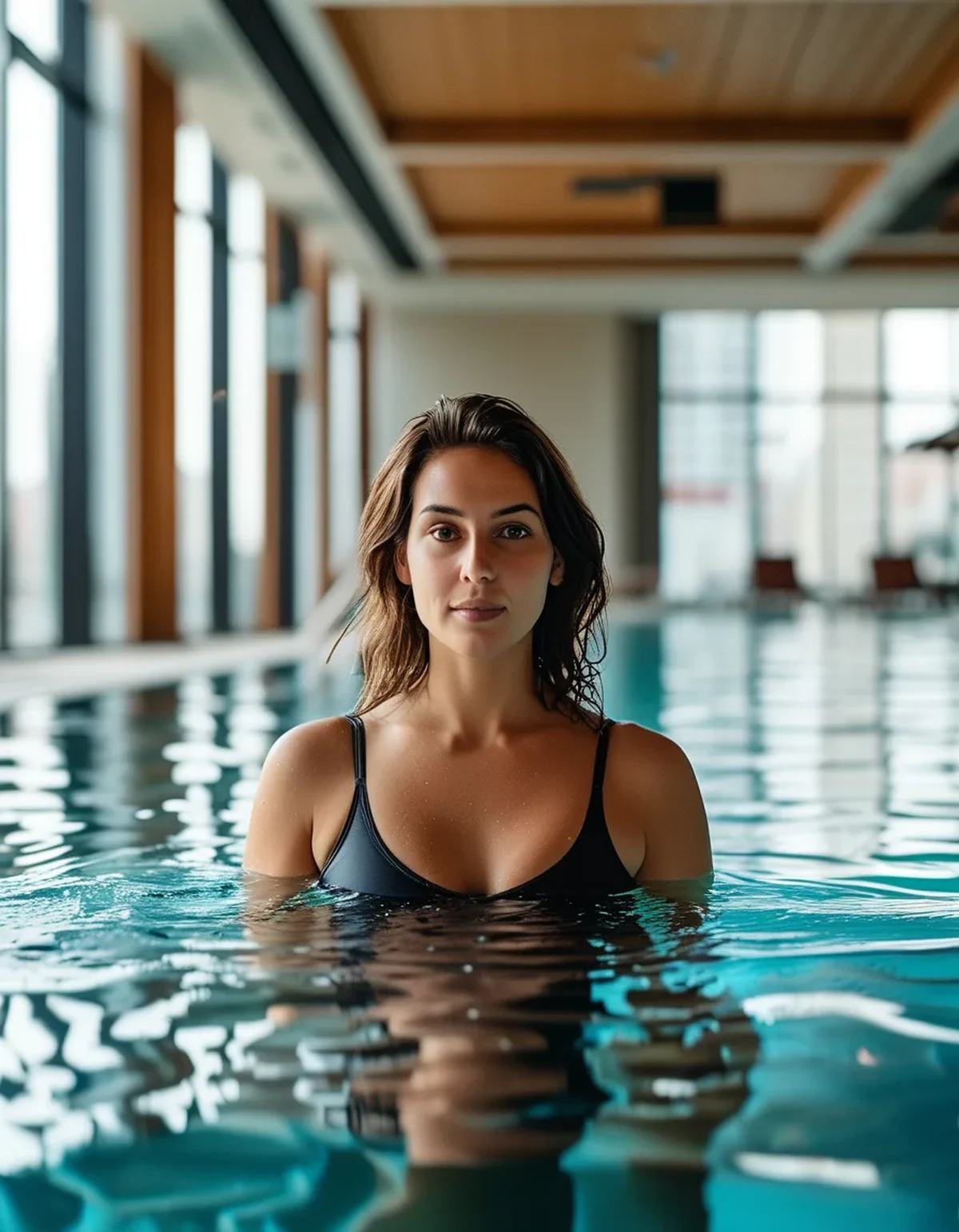
Frequency is the real change, not chemistry. Summer outdoor swimming is often two or three times a week with plenty of sun and air time in between. A committed indoor season can mean four or five sessions in a heated, humid, chlorinated environment. The cumulative exposure is what causes the problems people blame on indoor pools.
Wet your hair with clean water before you get in. Hair absorbs water like a sponge, and hair that is already saturated with tap water absorbs substantially less pool water. This ten-second step is the highest-return item in the entire routine and almost nobody does it.
Add a leave-in conditioner or a light oil before the cap. It creates a physical barrier and makes post-swim detangling far easier. Coconut or argan oil works; so does any conditioner you already own.
Wear a silicone cap over a fabric one if you need real protection. Silicone alone slides; fabric alone soaks. The combination is what competitive swimmers use and it genuinely reduces exposure.
Rinse immediately, properly, at the facility. The gap between exiting the pool and rinsing is when chlorine sits on hair and skin doing damage. A full rinse before you change, not when you get home, is the standard.
Use a chelating or clarifying shampoo once a week, not every session - it strips buildup, including the copper compounds responsible for greenish tinting in light hair, but daily use over-strips. Follow with a deep conditioner.
For skin, moisturize while damp, within three minutes of towelling. Chlorinated water strips the skin barrier, and the humid pool environment gives an illusion of hydration that disappears on the walk to the car. A ceramide-containing cream applied to damp skin is the most effective version.
And rinse your swimsuit in cold water after every single session. Chlorine degrades elastane continuously, and an indoor season of five sessions a week will destroy a suit in a few months if it goes into a bag wet and comes out the next day. Two suits in rotation, rinsed and dried flat away from direct heat, last dramatically longer.
5 Mistakes People Make in the Seasonal Transition
Mistake one: taking a short break first. The plan is always to rest for a week or two and then find an indoor pool. That break is where the habit dies. Overlap the two by at least one week - go indoors once while the outdoor pool is still open, so the new routine exists before the old one ends.
Mistake two: judging fitness by how the first indoor session feels. As covered above, warmer water and humid air raise perceived exertion substantially. People conclude they have lost a summer of fitness in one session, which is both false and the most common trigger for quitting.
Mistake three: switching to a completely different activity. The reasoning is sensible - the pool is closed, so try the gym. In practice, switching modality and environment and schedule simultaneously stacks three adjustments at once, and the aqua fitness habit rarely comes back in spring. If you want to add land-based training, add it alongside, not instead.
Mistake four: signing an annual membership on the first visit. September is peak sales season for facilities and peak optimism for members. Confirm the pool temperature, the depth, the class schedule in January, and the crowd level at your actual training time before committing twelve months.
Mistake five: keeping the summer session length. A 60-minute session in cool outdoor water is not equivalent to 60 minutes in a warm indoor pool. Cut to 40 or 45 for the first two weeks and build back. Ending a session feeling good is what gets you to the next one; grinding through a session that overheats you does not.
The pattern behind all five: protect frequency above everything. Intensity, duration, and program sophistication can all be rebuilt in a fortnight. A habit that lapses for six weeks in October usually does not come back until May.
What are the genuine advantages of the indoor season?
Consistency stops depending on weather. No cancelled sessions for storms, no unbearable heat weeks, no closures for lightning. Over a full winter, an indoor pool delivers a substantially higher number of completed sessions than an outdoor one delivers over a summer.
Programming is usually far better. Indoor facilities run their serious class schedules in the cooler months, when demand is highest. Aqua fitness, aqua HIIT, arthritis-focused warm-water classes, deep-water running, and aqua strength sessions are usually more numerous between October and March than in July.
Warm water is a genuine benefit for joint conditions. For arthritis, chronic pain, and post-surgical rehabilitation, warmer water reduces stiffness and improves range of motion. If you have been managing joint symptoms in a cool outdoor pool, an indoor warm-water program may be materially better for you, not merely a substitute.
The community is different and often stronger. Summer outdoor pools attract casual users; the indoor winter crowd is largely committed regulars. The social accountability that comes with recognizing eight faces in a Tuesday class is one of the most underrated retention tools in fitness.
And the light matters more than you would expect. A bright indoor pool with good windows during a dark northern winter is a genuinely valuable place to spend three hours a week. People frequently report that the winter pool habit does more for mood than the summer one did, precisely because it lands in the season that needs it.
Set a marker for spring. Note today’s date and a simple benchmark - how long you can maintain a deep-water run, or how a standard class feels on a 1 to 10 scale. Check it again in March. Almost everyone who trains consistently through an indoor winter is measurably fitter by spring than they were in September, which is the opposite of what the transition week feels like.
This is general information, not medical advice. If you have a heart condition, are pregnant, or are managing a specific injury, check with a healthcare professional about warm-water exercise, since warmer pools raise cardiovascular demand and core temperature more than cool water does.
TL;DR:
- Indoor pools usually run warmer and sit under humid air, which raises perceived exertion - expect roughly two weeks of adjustment and cut session length by a quarter to start.
- Check depth and lane layout in your first visit and convert travelling movements to stationary versions if the aqua fitness space is small.
- Book and attend the indoor slot while the outdoor pool is still open; the gap is what kills the habit, not the weather.
- Ask about pool temperature, depth, and the January class schedule before committing to an annual membership.
- Build a chlorine routine now: pre-wet hair, leave-in conditioner, immediate rinse, weekly clarifying shampoo, moisturize damp, and rinse the suit every session.
- The indoor season usually delivers better programming, more consistency, warmer water for joints, and a stronger community than the summer one.
The first week of September ends a lot of good habits for entirely logistical reasons. Handle the logistics in August, expect the first four sessions to feel harder than they are, and you will arrive at March fitter than you left the outdoor pool.
Keep Reading
This article is for general informational purposes only and is not medical advice. Always consult a qualified health professional for guidance specific to you.