The Pool Noodle: From Kids' Toy to Legitimate Gym Equipment
Quick Answer: A pool noodle works as resistance equipment because buoyancy pushes it up while you push it down — the harder you press, the harder it resists. Five moves cover a full-body session: the noodle press, noodle jog, seated bicycle, side sweeps, and balance work. Zero impact, about $3, and the shallow end is all the gym you need.
In the hierarchy of gym equipment, the pool noodle sits somewhere below the resistance band you keep meaning to use.
Which is precisely why nobody has noticed that it’s a genuine resistance machine costing three dollars.
Water flips the physics: instead of fighting gravity downward, you’re fighting buoyancy upward. Same muscles, opposite direction, and none of the joint load. The noodle has been waiting in the kids’ bin for someone to take it seriously.

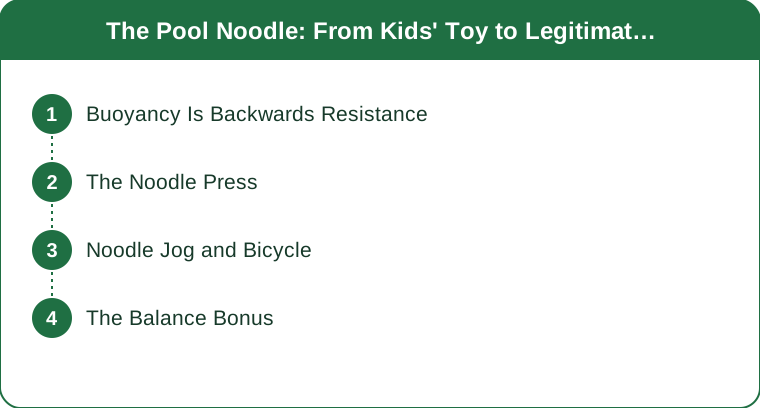
Why Does a Pool Noodle Work as Resistance?
Two forces are doing the work.
Buoyancy. Foam wants to float. Pushing it underwater means fighting that upward force the entire way — and unlike a dumbbell, it resists in a direction gravity normally helps you with. Pushing a noodle down is a press; letting it rise slowly is the eccentric portion.
Water drag. Moving anything through water meets resistance proportional to how fast you move it. This is the elegant part: the water auto-adjusts to your effort. Move slowly and it’s gentle; move fast and it fights back hard. You cannot accidentally use too much weight.
Add in the fact that water removes almost all impact from joints, and you’ve got a training environment that’s genuinely useful for anyone with knee, hip, or back issues — and still demanding enough to leave you tired.
What Are the Best Pool Noodle Exercises?
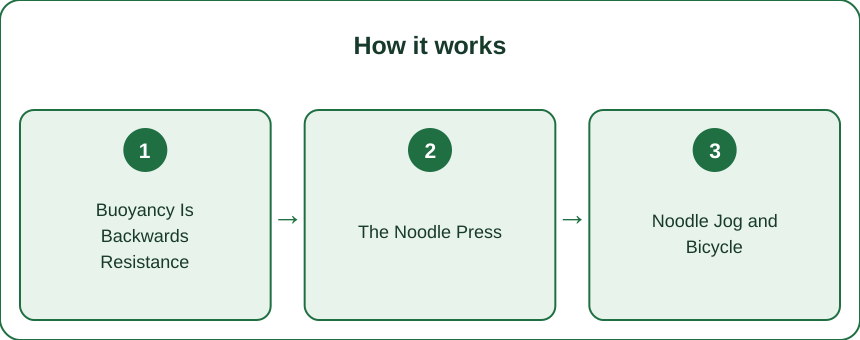
1. The Noodle Press
Stand chest-deep, hold the noodle horizontally with both hands, arms extended in front. Press it straight down toward your hips, then let it rise slowly under control.
10-15 reps. Works chest, shoulders, triceps, and core — the core because your body wants to be pushed backward and you have to stop it.
2. The Noodle Jog
Straddle the noodle in deeper water like a foam pony and jog or cycle your legs. 2-3 minutes.
Zero impact, full cardio, moderate loss of dignity. That’s the standard aqua fitness trade and it’s worth it every time.
3. Seated Bicycle
Same straddle position, but lean back slightly and pedal with your legs extended further forward. 60-90 seconds. This one moves the emphasis onto the core and hip flexors, and it’s harder than it looks.

4. Side Sweeps
Hold the noodle vertically with one hand, arm extended, and sweep it across your body through the water and back. 10 each side. Excellent for obliques and shoulders, and the drag makes it surprisingly demanding.
5. Balance Work
In shallow water, place one foot on a submerged noodle, or kneel on it, and try to hold still.
You will wobble enormously. That wobble is your core, ankles, and stabilizers working hard — and if you fall, the water is extremely forgiving about it. 30-60 seconds per attempt.
What Nobody Tells You About Water Workouts
You sweat, you just can’t tell. The water masks it completely, which is why dehydration sneaks up on people in pools. Bring a bottle and drink during your session — you need it as much as you would on land.
Slower is harder. This is counterintuitive on land and backwards in water. Because drag scales with speed, moving deliberately through a full range with control is more demanding than thrashing quickly through a short one.
Chest-deep is the sweet spot for most exercises. Too shallow and you lose the resistance; too deep and you lose your footing and the ability to brace.
Noodles come in densities. The cheap floppy ones bend under load and provide less resistance. A firmer, denser noodle is noticeably more effective — and still about four dollars.
Two noodles doubles the load. Once the press gets easy, one in each hand, or a thicker noodle. That’s your progression ladder, and it costs six dollars total.
Mini FAQ
Do I need to be able to swim?
Not for the standing exercises — chest-deep water with your feet on the bottom is fine for the press, sweeps, and balance work. The straddle-and-jog moves happen in deeper water, so you’ll want to be comfortable being unable to touch the floor, or stay in the shallow end for those.
Is a pool noodle workout actually effective?
For muscular endurance, cardiovascular fitness, and joint-friendly conditioning, yes. It won’t build maximal strength the way heavy resistance training does, but as low-impact full-body work — especially for anyone managing arthritis or recovering from injury — it’s genuinely useful.
How long should a pool noodle session be?
Twenty to thirty minutes of continuous work is a solid session. Cycle through the five exercises twice with brief rests, and you’ll have covered upper body, lower body, core, and cardio.
TL;DR:
- Buoyancy plus water drag turns a $3 foam noodle into resistance that auto-adjusts to your effort.
- Five moves: noodle press, noodle jog, seated bicycle, side sweeps, balance work.
- Move slowly and with control — slower is genuinely harder in water.
- Chest-deep water is the sweet spot for standing exercises.
- You’re sweating even though you can’t feel it: bring water and drink during the session.
Keep Reading
This article is for general informational purposes only and is not medical advice. Always consult a qualified health professional for guidance specific to you.