5 Water Workout Formats for 5 Different Fitness Goals — Which Pool Depth and Style Actually Matches Yours
Quick Answer: Match the format to the goal: shallow-water walking for joint-friendly cardio, deep-water running for zero-impact high intensity, resistance-equipment classes for strength, water aerobics for social low-impact cardio, and lap-based interval swimming for endurance — depth and equipment should follow your specific goal.
Water workouts get lumped together as one category, but a slow shallow-end walking session and a deep-water interval run are almost entirely different training stimuli. Picking the wrong format for your actual goal is a common reason water workouts feel like they’re not ‘doing enough.’

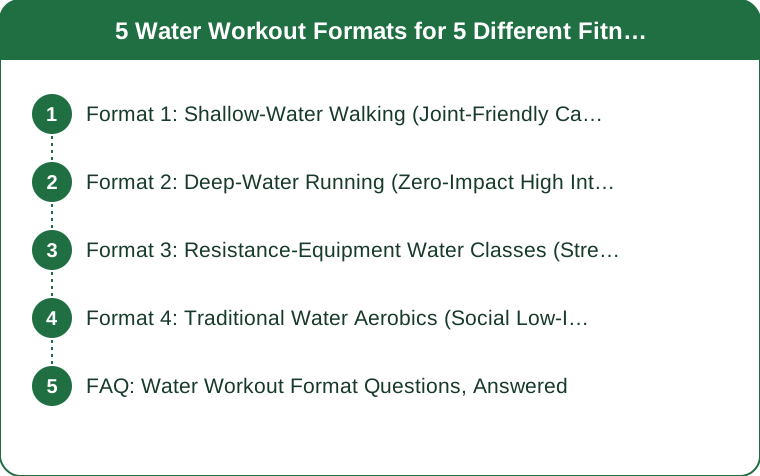
Format 1: Shallow-Water Walking (Joint-Friendly Cardio)
Waist-to-chest deep water, walking forward, backward, and laterally against resistance. This is the lowest-impact, most accessible format, ideal for anyone managing joint pain or returning from injury.
Goal fit: general cardio and joint-friendly movement, not primarily strength or high intensity — expect a moderate, sustainable heart rate rather than a max-effort session.
Format 2: Deep-Water Running (Zero-Impact High Intensity)
Using a flotation belt in water too deep to touch bottom, mimicking a running motion with zero joint impact. This is the closest water equivalent to genuine high-intensity cardio.
Goal fit: cardiovascular conditioning at real intensity for people who can’t tolerate land-based running impact — this format specifically targets intensity, not just gentle movement.

Format 3: Resistance-Equipment Water Classes (Strength)
Using water dumbbells, noodles, or resistance gloves to add load against water’s natural resistance, typically in chest-deep water with structured strength-focused sets.
Goal fit: building and maintaining muscle strength with joint-friendly loading — water resistance scales with how hard you push, making it genuinely adjustable rather than fixed like most land equipment.
Format 4: Traditional Water Aerobics (Social Low-Impact Cardio)
Group class format, choreographed movements, moderate continuous intensity, usually with music. This is the most socially structured option and often the easiest to stay consistent with long-term.
Goal fit: sustainable low-impact cardio with built-in accountability from a group setting — less about maximal intensity, more about consistency and enjoyment as the actual training driver.
FAQ: Water Workout Format Questions, Answered
Which water workout format burns the most calories?
Deep-water running tends to produce the highest heart rate and calorie burn among common formats, due to its higher achievable intensity without impact limiting effort.
Can water workouts actually build strength, not just cardio fitness?
Yes — resistance-equipment water classes specifically target strength, and water’s resistance scales with movement speed and force, offering genuine progressive loading.
Do I need to know how to swim for any of these formats?
Shallow-water walking, resistance classes, and standard water aerobics don’t require swimming ability. Deep-water running with a flotation belt is also swim-skill-independent, though comfort in deep water helps.
TL;DR:
- Shallow walking = joint-friendly cardio; deep-water running = zero-impact high intensity
- Resistance-equipment classes specifically target strength, not just cardio
- Traditional water aerobics prioritizes consistency and social accountability over max intensity
- Match depth and equipment to your actual goal instead of treating all water workouts as interchangeable
The right water workout isn’t the most popular one — it’s the format that actually matches what you’re training for.
Keep Reading
This article is for general informational purposes only and is not medical advice. Always consult a qualified health professional for guidance specific to you.